Epiphany 6 - Year C
Psalm 99
"Mighty King, lover of justice", is an image we aren't willing to see in one another. We know how we spin things to get what we want (is this another image of G*D?) and are therefore not willing to entrust justice to another. It is as though we have "executed" justice and righteousness before they could be proven useful in our midst.
Let's think about what it means to be made in an image of creativity. How do you rank the importance these three images of G*D or gods: namer of animals, cleaver to another, or lover of justice? Now, what other image of G*D is important to you and where would your rank it? Follow this pattern long enough and it is likely that you will find the image that makes you shine because you are doing your being.
In whatever ways Moses, Aaron, and Samuel (as well as Zipporah, Miriam, and Hannah) image G*D's forgiveness, justice, and righteousness, so might you and I. Yes? Yes! So, keep on keeping on with all of that and more (including G*D's play, work, and artistry imaged in you).
Wednesday, February 10, 2010


Tuesday, February 09, 2010
Exodus 34:29-35
Epiphany 6 - Year C
Exodus 34:29-35
Today's world associates a shining, glowing face with a happy face; an I-get-to-do-what-I-want-to-do face.
Moses' face shone as a result of an encounter with G*D's limits. If you see Moses coming toward you with a shining face - run! - you can bet there is going to be another boundary for your life coming.
While there are blessings in limits, they seem to bring a temptation to test them. We don't accede to them simply because they are attributed to G*D. Moses' shining face reveals how unreflective of the god's images we are. We are not eager to see such shining in orbit around our black hole sucking everything toward our id.
The veil approach (closeting) didn't work then and doesn't work now. Let the energy of life that brings healing flow and let the commandments shaping us toward healing beam their warning lights. We, like Moses, live within these poles.
Exodus 34:29-35
Today's world associates a shining, glowing face with a happy face; an I-get-to-do-what-I-want-to-do face.
Moses' face shone as a result of an encounter with G*D's limits. If you see Moses coming toward you with a shining face - run! - you can bet there is going to be another boundary for your life coming.
While there are blessings in limits, they seem to bring a temptation to test them. We don't accede to them simply because they are attributed to G*D. Moses' shining face reveals how unreflective of the god's images we are. We are not eager to see such shining in orbit around our black hole sucking everything toward our id.
The veil approach (closeting) didn't work then and doesn't work now. Let the energy of life that brings healing flow and let the commandments shaping us toward healing beam their warning lights. We, like Moses, live within these poles.
Monday, February 08, 2010
Luke 9:28-36 (37-43)
Epiphany 6 - Year C
Luke 9:28-36 (37-43)
We began Epiphany with a star in the west, drawing eastern magi on. We close the season with another shining - that of apparel. Whether you sense new light on the horizon or close surrounding you, there is one persistent blessing - that of belovedness. Whether your light is attributed to a creation-wide spirit of star-stuff or some very specific manifestation of same, there is always the question of what difference such makes.
Here there is healing in the wings. As folks return from enlightenment a healing need moves from the wings to center stage. "Look! Look!", cries an eternal chorus. As the scene progresses there is a heightening from description of seizure to experience of convulsion.
This and many healings first elicit a powerful, "No!" How astounding it is to break free of inertia to say, "No!" Where might you practice this today? Just mutter "No!" to yourself in response to the "news of the day", so you won't be taken in by the easy descriptions and avoidance of experience? Just state "No!" to someone else you encounter at home, business, or on the street, for together your "No!" will be strengthened? Just demand "No!" in and to your congregation, community, or nation, that a response to systemic illness can begin and eventually open space for a "Yes!"?
Accepting Belovedness eventuates in a rebuking "No!" and a healing "Yes!" May your star-stuffed belovedness so proclaim.
Luke 9:28-36 (37-43)
We began Epiphany with a star in the west, drawing eastern magi on. We close the season with another shining - that of apparel. Whether you sense new light on the horizon or close surrounding you, there is one persistent blessing - that of belovedness. Whether your light is attributed to a creation-wide spirit of star-stuff or some very specific manifestation of same, there is always the question of what difference such makes.
Here there is healing in the wings. As folks return from enlightenment a healing need moves from the wings to center stage. "Look! Look!", cries an eternal chorus. As the scene progresses there is a heightening from description of seizure to experience of convulsion.
This and many healings first elicit a powerful, "No!" How astounding it is to break free of inertia to say, "No!" Where might you practice this today? Just mutter "No!" to yourself in response to the "news of the day", so you won't be taken in by the easy descriptions and avoidance of experience? Just state "No!" to someone else you encounter at home, business, or on the street, for together your "No!" will be strengthened? Just demand "No!" in and to your congregation, community, or nation, that a response to systemic illness can begin and eventually open space for a "Yes!"?
Accepting Belovedness eventuates in a rebuking "No!" and a healing "Yes!" May your star-stuffed belovedness so proclaim.
Friday, February 05, 2010
entrusted lives
Epiphany 5 - Year C
entrusted lives
beside a lake
or in a boat
without craning
or bowing
proclamations
come and go
go out
into the deep
go for good
transparent
thankful
as you are
emboldened
with commission
persistent
with call
always
with singing
entrusted lives
beside a lake
or in a boat
without craning
or bowing
proclamations
come and go
go out
into the deep
go for good
transparent
thankful
as you are
emboldened
with commission
persistent
with call
always
with singing
Thursday, February 04, 2010
1 Corinthians 15:1-11
Epiphany 5 - Year C
1 Corinthians 15:1-11
Tricky brother Paul tests the Corinthians on "good news" - is it creedal or experiential?
He begins with Jesus, Jesus, Jesus, according to the scriptures. Key here is the straitjacket of scripture. Meet this criterion and the next and next. That's it. It's all about the dying (Romans) and burying (Arimathean Joseph) and raising (G*D). These are all external matters. It seems not to be about the living, just the matching with predetermined outcomes.
Second, I am what I am. Key here is a relationship (with a few prideful comments about working harder that those other apostles) with grace.
So, Corinthians, are you going to stake your good news on interpretations of scripture or experience of grace? Are these strictly equal or are we to decide which trumps which? By and large, the church institutional has come to bet on control of interpretation. That has grown old and is being seen through. To be one's self, maturing in one's gifts and responses to opportunities, is an important edge of new growth - good news.
What did Paul intend to remind us of? If he wasn't dazzled by his own footwork, I'm betting it was that grace is still open.
1 Corinthians 15:1-11
Tricky brother Paul tests the Corinthians on "good news" - is it creedal or experiential?
He begins with Jesus, Jesus, Jesus, according to the scriptures. Key here is the straitjacket of scripture. Meet this criterion and the next and next. That's it. It's all about the dying (Romans) and burying (Arimathean Joseph) and raising (G*D). These are all external matters. It seems not to be about the living, just the matching with predetermined outcomes.
Second, I am what I am. Key here is a relationship (with a few prideful comments about working harder that those other apostles) with grace.
So, Corinthians, are you going to stake your good news on interpretations of scripture or experience of grace? Are these strictly equal or are we to decide which trumps which? By and large, the church institutional has come to bet on control of interpretation. That has grown old and is being seen through. To be one's self, maturing in one's gifts and responses to opportunities, is an important edge of new growth - good news.
What did Paul intend to remind us of? If he wasn't dazzled by his own footwork, I'm betting it was that grace is still open.
Wednesday, February 03, 2010
Psalm 138
Epiphany 5 - Year C
Psalm 138
The Psalmist calls G*D.
Peter was commissioned by Jesus.
Isaiah responds to a question from on high.
There are so many ways to be in relationship to G*D. Each with its strength and weakness.
Callers can get to be a bit presumptuous. Thanks can slide over to bribery by an effusive tongue.
Those commissioned can attempt to change the commission of the one who commissioned them, thus changing their own commission to something with which they are more comfortable.
Responders may have the easiest time as the question and response format begins a relationship, they don't have to bring the other side in or try to haggle for a better deal.
Has your story mostly been that of Psalmist, Peter, or Isaiah? After taking a second look at that question, where is it now and where would you like it to be?
Psalm 138
The Psalmist calls G*D.
Peter was commissioned by Jesus.
Isaiah responds to a question from on high.
There are so many ways to be in relationship to G*D. Each with its strength and weakness.
Callers can get to be a bit presumptuous. Thanks can slide over to bribery by an effusive tongue.
Those commissioned can attempt to change the commission of the one who commissioned them, thus changing their own commission to something with which they are more comfortable.
Responders may have the easiest time as the question and response format begins a relationship, they don't have to bring the other side in or try to haggle for a better deal.
Has your story mostly been that of Psalmist, Peter, or Isaiah? After taking a second look at that question, where is it now and where would you like it to be?
Tuesday, February 02, 2010
Isaiah 6:1-8 (9-13)
Epiphany 5 - Year C
Isaiah 6:1-8 (9-13)
The year before old Uzziah died, Isaiah was feeling good. Uzziah's long reign was known for its lack of warfare and its prosperity. Uzziah's early following of his advisor Zechariah had born much good fruit. Surely Uzziah's difficulty with leprosy from one small convening of theocratic law (then equivalent of international treaty) would soon come to an end with his full restoration.
As Uzziah comes to an end it becomes obvious to some that the relative peace and prosperity during his reign of Judah was not going to last long. This political timing brought with it a "thin space" for Isaiah. He becomes realistically separated from those who presumed their past paradigms and politics would suffice. Any difficulty could easily be blamed on the new king and never need to take into account changing economies, relations with former partners, or a new power on the horizon.
Isaiah's guilt of complicity in the former realm and misguided understanding of where security and wholeness lay was taken from him, like morning film from sleepy eyes. From this moment of awaking, Isaiah would not return to the fold of prevailing thought.
It turned out to be easier than first thought to dull the minds of those around Isaiah. Past mantras, such as "no taxes", became a source of weakness, not strength, for the country. When a community is more concerned about sustaining wealth than the poor, it is not only an opening to a thin space of reorientation, but it is the culmination of an era.
May you be "a holy seed in the stump" of our current political transition time. In a coming of "nothingness upon the land" (see The Neverending Story and be sure to get this edition, for the two second color print for the story within the story is well worth the price) may your own response to your guilt of complicity with a past way of denial be transformed into a beacon of hopeful action.
Isaiah 6:1-8 (9-13)
The year before old Uzziah died, Isaiah was feeling good. Uzziah's long reign was known for its lack of warfare and its prosperity. Uzziah's early following of his advisor Zechariah had born much good fruit. Surely Uzziah's difficulty with leprosy from one small convening of theocratic law (then equivalent of international treaty) would soon come to an end with his full restoration.
As Uzziah comes to an end it becomes obvious to some that the relative peace and prosperity during his reign of Judah was not going to last long. This political timing brought with it a "thin space" for Isaiah. He becomes realistically separated from those who presumed their past paradigms and politics would suffice. Any difficulty could easily be blamed on the new king and never need to take into account changing economies, relations with former partners, or a new power on the horizon.
Isaiah's guilt of complicity in the former realm and misguided understanding of where security and wholeness lay was taken from him, like morning film from sleepy eyes. From this moment of awaking, Isaiah would not return to the fold of prevailing thought.
It turned out to be easier than first thought to dull the minds of those around Isaiah. Past mantras, such as "no taxes", became a source of weakness, not strength, for the country. When a community is more concerned about sustaining wealth than the poor, it is not only an opening to a thin space of reorientation, but it is the culmination of an era.
May you be "a holy seed in the stump" of our current political transition time. In a coming of "nothingness upon the land" (see The Neverending Story and be sure to get this edition, for the two second color print for the story within the story is well worth the price) may your own response to your guilt of complicity with a past way of denial be transformed into a beacon of hopeful action.
Monday, February 01, 2010
Luke 5:1-11
Epiphany 5 - Year C
Luke 5:1-11
Apparently Simon is a Class-A net washer. After a night of nothing caught it wouldn't take much to have washed his net. This explains (always a dangerous thing to do with scripture stories as it turns them into facts) how Simon was able to have a net in the boat already out on the water while others were still washing theirs on the shore. It may also have something to do with Simon's slow response - after a frustrating night of fishing and a fast wash-up he may not have been listening all that well, after all, he wasn't one of the crowd pressing to hear about G*D, he was just someone pressed into service - the chauffeur doesn't have to listen to speech, just drive to a good speaking spot.
Simon was a realistic enough small businessman to know that a glut of fish would decrease their value (good old supply and demand) and that broken nets were a whole different kettle of fish than dirty nets. Might as well leave the current situation behind and move on, follow on.
That is all fun playing with the story. Of equal import is a look at Simon's response of, "Go away, I am without stock in your company." [track hamartōlos back to hamartanō] Simon was not in on Jesus' original IPO. This event was too good to keep his current partnership sustainable. Sort of like small businesses when a Wal-Mart shows up in the community. Simon knows tides come and tides go; fish are caught and not caught; life goes on, follows on.
This "sinner" language, as it is usually translated, is more appropriate in John's similar post-resurectional scene. It is also a bit out of place since Jesus doesn't seem to pick up on the "sinner" language with his commissioning of Simon, et al. It is almost as if Jesus says, "Sinner, Schminner, whatever. Here's the deal . . . . Are you in or not?"
Well, are you?
Luke 5:1-11
Apparently Simon is a Class-A net washer. After a night of nothing caught it wouldn't take much to have washed his net. This explains (always a dangerous thing to do with scripture stories as it turns them into facts) how Simon was able to have a net in the boat already out on the water while others were still washing theirs on the shore. It may also have something to do with Simon's slow response - after a frustrating night of fishing and a fast wash-up he may not have been listening all that well, after all, he wasn't one of the crowd pressing to hear about G*D, he was just someone pressed into service - the chauffeur doesn't have to listen to speech, just drive to a good speaking spot.
Simon was a realistic enough small businessman to know that a glut of fish would decrease their value (good old supply and demand) and that broken nets were a whole different kettle of fish than dirty nets. Might as well leave the current situation behind and move on, follow on.
That is all fun playing with the story. Of equal import is a look at Simon's response of, "Go away, I am without stock in your company." [track hamartōlos back to hamartanō] Simon was not in on Jesus' original IPO. This event was too good to keep his current partnership sustainable. Sort of like small businesses when a Wal-Mart shows up in the community. Simon knows tides come and tides go; fish are caught and not caught; life goes on, follows on.
This "sinner" language, as it is usually translated, is more appropriate in John's similar post-resurectional scene. It is also a bit out of place since Jesus doesn't seem to pick up on the "sinner" language with his commissioning of Simon, et al. It is almost as if Jesus says, "Sinner, Schminner, whatever. Here's the deal . . . . Are you in or not?"
Well, are you?
Friday, January 29, 2010
Fulfillment
Epiphany 4 - Year C
today
fulfills the past
our infancy is revisable
fulfillment erases
all manner of memory
fulfillment displaces
any and all limits
There will be no curiosity, no enjoyment of the process of life. All competing pleasures will be destroyed. But always — do not forget this, Winston — always there will be the intoxication of power, constantly increasing and constantly growing subtler. Always, at every moment, there will be the thrill of victory, the sensation of trampling on an enemy who is helpless. If you want a picture of the future, imagine a boot stamping on a human face . . . for ever. [1984]
today
begins tomorrow
our future is caste
fulfillment completed
erase faith
fulfillment fulfilled
displace hope
soma is enough
There's always soma to calm your anger, to reconcile you to your enemies, to make you patient and long-suffering. In the past you could only accomplish these things by making a great effort and after years of hard moral training. Now, you swallow two or three half-gramme tablets, and there you are. Anybody can be virtuous now. You can carry at least half your morality about in a bottle. Christianity without tears - that's what soma is." [Brave New World]
today
reveals continuums
our present vibrates
fulfillment awaits
love's dance
fulfillment makes room
engaging gifts
face-to-face
today
fulfills the past
our infancy is revisable
fulfillment erases
all manner of memory
fulfillment displaces
any and all limits
There will be no curiosity, no enjoyment of the process of life. All competing pleasures will be destroyed. But always — do not forget this, Winston — always there will be the intoxication of power, constantly increasing and constantly growing subtler. Always, at every moment, there will be the thrill of victory, the sensation of trampling on an enemy who is helpless. If you want a picture of the future, imagine a boot stamping on a human face . . . for ever. [1984]
today
begins tomorrow
our future is caste
fulfillment completed
erase faith
fulfillment fulfilled
displace hope
soma is enough
There's always soma to calm your anger, to reconcile you to your enemies, to make you patient and long-suffering. In the past you could only accomplish these things by making a great effort and after years of hard moral training. Now, you swallow two or three half-gramme tablets, and there you are. Anybody can be virtuous now. You can carry at least half your morality about in a bottle. Christianity without tears - that's what soma is." [Brave New World]
today
reveals continuums
our present vibrates
fulfillment awaits
love's dance
fulfillment makes room
engaging gifts
face-to-face
Thursday, January 28, 2010
1 Corinthians 13:1-13
Epiphany 4 - Year C
1 Corinthians 13:1-13
"When I was an infant at my mother's breast, I gurgled and cooed like any infant. When I grew up, I left those infant ways for good." [The Message]
Isn't it good to be able to know we recapitulated the development of all people. We are not divinity wrapped in flesh. We are both at each stage along the way. Sometimes it is more evident and sometimes less, but is never one or the other.
In acknowledgement of our past we can glory in our poopy pants (Merriam-Webster online reminds us that "poop" can refer to a ship's stern/rear, defecation, exhaustion, or information - sort of like the mystery of G*D's backside) and rejoice in those who cared for us when we couldn't do so for ourselves. We will leave our past behind, in terms of not repeating it, as we incorporate it into our present approach to life (caring) and our goals (seeing more and more clearly who we are in relationship to others). Our past is not embarrassment, but instructive and encouraging.
Can you see faith/trust, hope, and love at work in your infancy? Your present? Your time to come? In your friends/congregation/context as well as yourself? To see these qualities over time helps us become more comfortable with the ambiguity of partiality and to appreciate our latest developmental plateau, even as we consolidate and prepare to move on.
1 Corinthians 13:1-13
"When I was an infant at my mother's breast, I gurgled and cooed like any infant. When I grew up, I left those infant ways for good." [The Message]
Isn't it good to be able to know we recapitulated the development of all people. We are not divinity wrapped in flesh. We are both at each stage along the way. Sometimes it is more evident and sometimes less, but is never one or the other.
In acknowledgement of our past we can glory in our poopy pants (Merriam-Webster online reminds us that "poop" can refer to a ship's stern/rear, defecation, exhaustion, or information - sort of like the mystery of G*D's backside) and rejoice in those who cared for us when we couldn't do so for ourselves. We will leave our past behind, in terms of not repeating it, as we incorporate it into our present approach to life (caring) and our goals (seeing more and more clearly who we are in relationship to others). Our past is not embarrassment, but instructive and encouraging.
Can you see faith/trust, hope, and love at work in your infancy? Your present? Your time to come? In your friends/congregation/context as well as yourself? To see these qualities over time helps us become more comfortable with the ambiguity of partiality and to appreciate our latest developmental plateau, even as we consolidate and prepare to move on.
Psalm 71:1-6
Epiphany 4 - Year C
Psalm 71:1-6
"Sheltering Rock" is the Hebrew behind "my rock and my fortress" and moves us away from static to dynamic imagery. This attending friend can show up in many a situation: external wars to internal aging. As a description of the Temple or an organizing principle it brings a response of thankfulness.
It is all too easy to make this psalm into a dramatic place where we go to appeal to and appease some larger entity. Consider the difference when we travel with, rather than to, a sense of refuge large enough that we are emboldened in action to proceed into the regular places of life with a sense of élan.
In the following letter to a local paper, "Sheltering Rock" is "a" type of language and "my Rock and my Fortress" is "the" talk. What do you think?
- - - - - - -
Haiti has had a literal earthquake that needs both immediate band-aids and long-term structural responses. In the United States our political lives give evidence of an invisible quake revealing faults, rifts, and gaps between families and parties. The State of the Union Address by President Obama reminded us of that in these words, "I know that all of us love this country. All of us are committed to its defense. So let's put aside the schoolyard taunts about who's tough. Let's reject the false choice between protecting our people and upholding our values. Let's leave behind the fear and division, and do what it takes to defend our nation and forge a more hopeful future...."
Whether a decision-making context (politics) is that of family, institution, community, nation, or international, a first step in dealing with our division is a sincere acknowledgment that we have a problem that has gone beyond our ability to deal with it. Without this confession, breeches between perspectives will widen.
There is a simple and manageable, though very difficult, behavior that can be used at every level of disagreement. It is a new way of talking that takes every-day and life-long practice - to change our language from the definiteness of "the" to a humbler, more flexible and realistic conversation about "a" particular when we are dealing with common issues.
Our ease at turning a given situation or perspective into universals for all times and situations can be noted by listening to conversations and our own statements. Check out how often you hear "the" talk canceling out all options and how substituting "a" opens us to the best from all sides meeting one another and moving us forward.
By putting so much emphasis upon "the", we convince ourselves that we are absolutely right, someone is to blame, and there is no good in another's question or wisdom in another's experience that would widen our perspective and deepen the value of a resolution to a common problem. I am hopeful that we haven't yet let gaps between us widen to the point where we can't yet join hands in a larger goal than point-proving.
Matters of import such as health care, energy and environment, and beneficial uses of taxes have many individual and communal aspects that need the best each of us have to offer. Though it seems too simplistic, an awareness of our language by which we address common issues, can actually be a huge step forward in effective action. I invite you to join me in the persistent work needed for deeper listening, clearer framing, and more inclusive responses to "life's persistent questions", as Guy Noir® would put it.
Psalm 71:1-6
"Sheltering Rock" is the Hebrew behind "my rock and my fortress" and moves us away from static to dynamic imagery. This attending friend can show up in many a situation: external wars to internal aging. As a description of the Temple or an organizing principle it brings a response of thankfulness.
It is all too easy to make this psalm into a dramatic place where we go to appeal to and appease some larger entity. Consider the difference when we travel with, rather than to, a sense of refuge large enough that we are emboldened in action to proceed into the regular places of life with a sense of élan.
In the following letter to a local paper, "Sheltering Rock" is "a" type of language and "my Rock and my Fortress" is "the" talk. What do you think?
- - - - - - -
Haiti has had a literal earthquake that needs both immediate band-aids and long-term structural responses. In the United States our political lives give evidence of an invisible quake revealing faults, rifts, and gaps between families and parties. The State of the Union Address by President Obama reminded us of that in these words, "I know that all of us love this country. All of us are committed to its defense. So let's put aside the schoolyard taunts about who's tough. Let's reject the false choice between protecting our people and upholding our values. Let's leave behind the fear and division, and do what it takes to defend our nation and forge a more hopeful future...."
Whether a decision-making context (politics) is that of family, institution, community, nation, or international, a first step in dealing with our division is a sincere acknowledgment that we have a problem that has gone beyond our ability to deal with it. Without this confession, breeches between perspectives will widen.
There is a simple and manageable, though very difficult, behavior that can be used at every level of disagreement. It is a new way of talking that takes every-day and life-long practice - to change our language from the definiteness of "the" to a humbler, more flexible and realistic conversation about "a" particular when we are dealing with common issues.
Our ease at turning a given situation or perspective into universals for all times and situations can be noted by listening to conversations and our own statements. Check out how often you hear "the" talk canceling out all options and how substituting "a" opens us to the best from all sides meeting one another and moving us forward.
By putting so much emphasis upon "the", we convince ourselves that we are absolutely right, someone is to blame, and there is no good in another's question or wisdom in another's experience that would widen our perspective and deepen the value of a resolution to a common problem. I am hopeful that we haven't yet let gaps between us widen to the point where we can't yet join hands in a larger goal than point-proving.
Matters of import such as health care, energy and environment, and beneficial uses of taxes have many individual and communal aspects that need the best each of us have to offer. Though it seems too simplistic, an awareness of our language by which we address common issues, can actually be a huge step forward in effective action. I invite you to join me in the persistent work needed for deeper listening, clearer framing, and more inclusive responses to "life's persistent questions", as Guy Noir® would put it.
Tuesday, January 26, 2010
Jeremiah 1:4-19
Epiphany 4 - Year C
Jeremiah 1:4-19
Jeremiah can be compared to Moses. Though this is the beginning of his life of prophecy, it extended for 40 years, as did Moses' work. Both begin their ministry with natural images - burning bush and almond branch. Both have priestly connections as well as prophetic. Both mark changes in eras - from captivity and into it.
Jeremiah represents a lifetime of calls (verses 1-3). I hope you are enjoying your latest call. There is no telling how long it will last before another comes along. So, gird up those loins, young or old, and grasp your walking stick for there are miles to go, calls to go.
In each of your calls there will be elements for you to:
pull up and tear down,
take apart and demolish,
and, then, start over,
building and planting.
This is simply a matter of a consequence of life. It cannot ethically be avoided. And so the call to enjoy your opportunities to participate in journeying with G*D and Neighbors, whether in a demolishing or planting call.
Jeremiah 1:4-19
Jeremiah can be compared to Moses. Though this is the beginning of his life of prophecy, it extended for 40 years, as did Moses' work. Both begin their ministry with natural images - burning bush and almond branch. Both have priestly connections as well as prophetic. Both mark changes in eras - from captivity and into it.
Jeremiah represents a lifetime of calls (verses 1-3). I hope you are enjoying your latest call. There is no telling how long it will last before another comes along. So, gird up those loins, young or old, and grasp your walking stick for there are miles to go, calls to go.
In each of your calls there will be elements for you to:
pull up and tear down,
take apart and demolish,
and, then, start over,
building and planting.
This is simply a matter of a consequence of life. It cannot ethically be avoided. And so the call to enjoy your opportunities to participate in journeying with G*D and Neighbors, whether in a demolishing or planting call.
Monday, January 25, 2010
Luke 4:21-30
Epiphany 4 - Year C
Luke 4:21-30
Yes, Jesus picked this particular fight with his hometown.
All was going swimmingly. Jesus reads Isaiah and claims it. Those in the synagogue were affirming. They marveled and remembered back to before Jesus saw John at the Jordan as well as stories of more recent exploits.
It would be interesting to get the back story of Jesus that led to his striking out at these close-to-adoring people. Does Jesus need some revisionist history instead of those who saw him scab his knee and run to Mary for a kiss on his boo-boo? Perhaps he is just tired from recent exploits and wanted to cut off requests for more. Whichever, whatever, Jesus is responsible for this event.
Can't you see the townspeople with their hooray, Jesus' response, and then the town folks angry response. How sad for all concerned. Hope, faith and love seem particularly absent in Jesus' attempt to leave his infancy behind.
While there is a tendency to equate this to Jesus' later entry into Jerusalem and the crowd changing from Hosanna to Hang-em, it is better to wrestle with this incident. What went wrong? Where do you see that same wrongness in these days?
Luke 4:21-30
Yes, Jesus picked this particular fight with his hometown.
All was going swimmingly. Jesus reads Isaiah and claims it. Those in the synagogue were affirming. They marveled and remembered back to before Jesus saw John at the Jordan as well as stories of more recent exploits.
It would be interesting to get the back story of Jesus that led to his striking out at these close-to-adoring people. Does Jesus need some revisionist history instead of those who saw him scab his knee and run to Mary for a kiss on his boo-boo? Perhaps he is just tired from recent exploits and wanted to cut off requests for more. Whichever, whatever, Jesus is responsible for this event.
Can't you see the townspeople with their hooray, Jesus' response, and then the town folks angry response. How sad for all concerned. Hope, faith and love seem particularly absent in Jesus' attempt to leave his infancy behind.
While there is a tendency to equate this to Jesus' later entry into Jerusalem and the crowd changing from Hosanna to Hang-em, it is better to wrestle with this incident. What went wrong? Where do you see that same wrongness in these days?
Friday, January 22, 2010
Today?
Epiphany 3 - Year C
Ahh, so many gifts and so many ways to respond to them with falsity.

http://www.agnusday.org/strips/1Corinthians12v3to13_2005.jpg
The gift of vocation is so easily subverted from within. Have you found your apostleship, teaching, healing, organizing, etc. subject to passive/aggressive or other tendencies?
So many gifts and so much fear to use them.

http://www.reverendfun.com/?date=20031201
Enough, already, you are who you are and will be who you will be. Time to get on with it, today in front of G*D and everyone, for "better" or "worse".
Ahh, so many gifts and so many ways to respond to them with falsity.
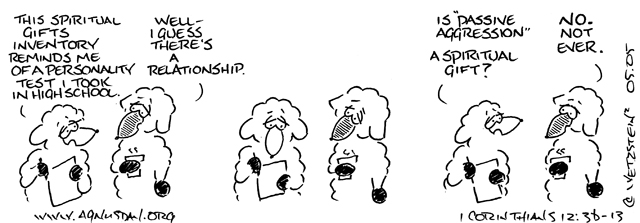
http://www.agnusday.org/strips/1Corinthians12v3to13_2005.jpg
The gift of vocation is so easily subverted from within. Have you found your apostleship, teaching, healing, organizing, etc. subject to passive/aggressive or other tendencies?
So many gifts and so much fear to use them.
http://www.reverendfun.com/?date=20031201
Enough, already, you are who you are and will be who you will be. Time to get on with it, today in front of G*D and everyone, for "better" or "worse".
Thursday, January 21, 2010
1 Corinthians 12:12-31a
Epiphany 3 - Year C
1 Corinthians 12:12-31a
Jesus was filled with the power of Gift.
You are filled with the power of Gift.
OK, there are varieties of gifts, but, please, with Gift there is no way to measure a greater gift from a lesser gift. Don't bother going there or striving there.
If striving is to be done, may it be that we strive to claim our Gift in this moment so that, "Today my Gift is being fulfilled through . . . ." is our rallying cry. When two or three are fulfilling their Gifts together, community is formed and prayers are responded to.
- - - - - - -
Those interested in such as a Gift coming-of-age book would do well to follow the Annals of the Western Shore series by Ursula Le Guin: Gifts, Voices, and Powers.
1 Corinthians 12:12-31a
Jesus was filled with the power of Gift.
You are filled with the power of Gift.
OK, there are varieties of gifts, but, please, with Gift there is no way to measure a greater gift from a lesser gift. Don't bother going there or striving there.
If striving is to be done, may it be that we strive to claim our Gift in this moment so that, "Today my Gift is being fulfilled through . . . ." is our rallying cry. When two or three are fulfilling their Gifts together, community is formed and prayers are responded to.
- - - - - - -
Those interested in such as a Gift coming-of-age book would do well to follow the Annals of the Western Shore series by Ursula Le Guin: Gifts, Voices, and Powers.
Wednesday, January 20, 2010
Psalm 19
Epiphany 3 - Year C
Psalm 19
Day says, "Let there be . . . ."
Night wisdom reveals, "And it is good."
Yet evening and morning are not heeded.
The on-goingness of creation carries no weight.
Likewise with laws and revelations, whether G*D's or not
they carry no weight.
Even warned, errors occur and are unrecognized.
So, how do I weigh my own words and heart?
Self-proclaimed as weighty (reprise Sen. Brown's "victory" speech)
and so weightless.
Weightless enough to be blameless and innocent
(not the highest of virtues in an incarnate world).
Now that we know enough to not take ourselves seriously
we can return to the top
to join day and night in
heightened expectation and expansive goodness.
Psalm 19
Day says, "Let there be . . . ."
Night wisdom reveals, "And it is good."
Yet evening and morning are not heeded.
The on-goingness of creation carries no weight.
Likewise with laws and revelations, whether G*D's or not
they carry no weight.
Even warned, errors occur and are unrecognized.
So, how do I weigh my own words and heart?
Self-proclaimed as weighty (reprise Sen. Brown's "victory" speech)
and so weightless.
Weightless enough to be blameless and innocent
(not the highest of virtues in an incarnate world).
Now that we know enough to not take ourselves seriously
we can return to the top
to join day and night in
heightened expectation and expansive goodness.
Tuesday, January 19, 2010
Nehemiah 8:1-3, 4-6, 8-10
Epiphany 3 - Year C
Nehemiah 8:1-3, 4-6, 8-10
Once again, all the news that's fit to print, isn't all the news. Even as others as illustrious as Moses have needed help to hold up their hands, Ezra needed others on the platform with him. Likewise, additional others were needed to teach, reinforce, and interpret all the had heard.
When these helpers are left out of the story we have extracted experience from creed. Imagine a Bible reader and a bunch of people. Pretty boring. It is in the interaction in community, beyond a printed page, where life happens. Verse 9c wouldn't have "the people weeping" simply from hearing - the interpreters were and are key and they were left out of this pericope.
Before placing too much on your dulcet tones intoning a communal covenant, remember those standing with you, near or far, and those who will be striving to help others make sense out of what comes out of your mouth. Go ahead, name these folks. The revelation you have to impart will only be enhanced by the naming. You are not in this alone: we're in it together - Ezra and Meshullam and Kelita and you and I.
Nehemiah 8:1-3, 4-6, 8-10
Once again, all the news that's fit to print, isn't all the news. Even as others as illustrious as Moses have needed help to hold up their hands, Ezra needed others on the platform with him. Likewise, additional others were needed to teach, reinforce, and interpret all the had heard.
When these helpers are left out of the story we have extracted experience from creed. Imagine a Bible reader and a bunch of people. Pretty boring. It is in the interaction in community, beyond a printed page, where life happens. Verse 9c wouldn't have "the people weeping" simply from hearing - the interpreters were and are key and they were left out of this pericope.
Before placing too much on your dulcet tones intoning a communal covenant, remember those standing with you, near or far, and those who will be striving to help others make sense out of what comes out of your mouth. Go ahead, name these folks. The revelation you have to impart will only be enhanced by the naming. You are not in this alone: we're in it together - Ezra and Meshullam and Kelita and you and I.
Luke 4:14-21
Epiphany 3 - Year C
Luke 4:14-21
Jesus, filled with Spirit power, returns to Galilee. What do you do when so filled?
The society column of the time not only noted who poured out at Mrs. Peter's, but who was traveling and where. The editorialists and pundits picked up on yet another bandwagon and wrote and talked, repeatedly, about the significance of Jesus as though he were an extension of their own preferences.
All these reports about Jesus were leading to confusion. On the appropriate Sabbath, Jesus took advantage of the reading of the day to proclaim, in no uncertain terms, in very certain class, economics, and power terms the trouble he was brewing - a revolutionary vision for the mobilization of the poor, freedom unreasonable seizure, reform of the privileged, and overcoming oppression. This was not only a challenge end and means of systems, but a challenge not to be delayed for another year (much less 49 years) - a challenge for right now, this year.
A follow-up question to what you do when Spirit-filled (become a brewer of trouble), asks when you will do it. Well? Any reason not to have your spirit-filling revealed today?
Luke 4:14-21
Jesus, filled with Spirit power, returns to Galilee. What do you do when so filled?
The society column of the time not only noted who poured out at Mrs. Peter's, but who was traveling and where. The editorialists and pundits picked up on yet another bandwagon and wrote and talked, repeatedly, about the significance of Jesus as though he were an extension of their own preferences.
All these reports about Jesus were leading to confusion. On the appropriate Sabbath, Jesus took advantage of the reading of the day to proclaim, in no uncertain terms, in very certain class, economics, and power terms the trouble he was brewing - a revolutionary vision for the mobilization of the poor, freedom unreasonable seizure, reform of the privileged, and overcoming oppression. This was not only a challenge end and means of systems, but a challenge not to be delayed for another year (much less 49 years) - a challenge for right now, this year.
A follow-up question to what you do when Spirit-filled (become a brewer of trouble), asks when you will do it. Well? Any reason not to have your spirit-filling revealed today?
Friday, January 15, 2010
variety
Epiphany 2 - Year C
variety
a most uncommon
common-good
dispersed
so widely
none can claim
status
miraculous
it is to use
miracle to hold
gift to gift
intermingled
interpretation balances wisdom
tongues and knowledge are paralleled
miracle sits in the middle
that is no middle
faith requires discernment
healing instructs
water
universal solvent
homeopathic intensifier
brings forth
wine
rejoice
for my sake
names change
dawn
steadfast
love-winged
gifts
variety
a most uncommon
common-good
dispersed
so widely
none can claim
status
miraculous
it is to use
miracle to hold
gift to gift
intermingled
interpretation balances wisdom
tongues and knowledge are paralleled
miracle sits in the middle
that is no middle
faith requires discernment
healing instructs
water
universal solvent
homeopathic intensifier
brings forth
wine
rejoice
for my sake
names change
dawn
steadfast
love-winged
gifts
Thursday, January 14, 2010
1 Corinthians 12:1-11
Epiphany 2 - Year C
1 Corinthians 12:1-11
I am always amused and aggravated at the way Paul can so easily slip from an either/or didacticism regarding Jesus' "name" to an open-ended appreciation of variety of gifts attributed to a Spirit of this same Jesus. I experience no harm to this pericope should verses 2 and 3 happen to get erased or not spoken when reading. Try it: 1 Corinthians 12:1, 4-11.
With that detail cared for, consider again the variety of images of G*D that G*D seems to have an appreciation for. They range from deserts to your life this day. All the named and unnamed gifts are expressions of an original blessing. Perhaps you will appreciate Chris Smither's song, "Origin of Species" - lyrics and performance.
For those of you who aren't into links, here is the pertinent section of the song:
God said: "I'll make some DNA"
They can use it any way they want
From paramecium
Right up to man."
"They'll have sex
And mix up sections of their code
They'll have mutations...
The whole thing works like clockwork over time."
"I'll just sit back in the shade
While everyone gets laid.
That's what I call
Intelligent design."
Yeah, you and your cat named Felix,
Both wrapped up in that double helix,
Is what we call
Intelligent design.
Paul calls this DNA "the same G*D who activates [each gift]". Appreciate an Original Blessing or First Gift that has manifested as you. Pretty amazing, are you!
1 Corinthians 12:1-11
I am always amused and aggravated at the way Paul can so easily slip from an either/or didacticism regarding Jesus' "name" to an open-ended appreciation of variety of gifts attributed to a Spirit of this same Jesus. I experience no harm to this pericope should verses 2 and 3 happen to get erased or not spoken when reading. Try it: 1 Corinthians 12:1, 4-11.
With that detail cared for, consider again the variety of images of G*D that G*D seems to have an appreciation for. They range from deserts to your life this day. All the named and unnamed gifts are expressions of an original blessing. Perhaps you will appreciate Chris Smither's song, "Origin of Species" - lyrics and performance.
For those of you who aren't into links, here is the pertinent section of the song:
God said: "I'll make some DNA"
They can use it any way they want
From paramecium
Right up to man."
"They'll have sex
And mix up sections of their code
They'll have mutations...
The whole thing works like clockwork over time."
"I'll just sit back in the shade
While everyone gets laid.
That's what I call
Intelligent design."
Yeah, you and your cat named Felix,
Both wrapped up in that double helix,
Is what we call
Intelligent design.
Paul calls this DNA "the same G*D who activates [each gift]". Appreciate an Original Blessing or First Gift that has manifested as you. Pretty amazing, are you!
Wednesday, January 13, 2010
Psalm 36
Epiphany 2 - Year C
Psalm 36
In the first verses we find "personified Transgression" living through those who listen to it. There is mischief afoot.
In the final verse the "evil doers" or "moral midgets" are found sprawled on the ground having tripped over their own mischievous feet.
Hints about how to avoid this comeuppance are found in the middle two verses. Here we are reminded about the value of a solidly grounded sense of rightness with judgments based on firm foundations and oriented toward the long-term. Here we know that salvation is universal; it is for all and won't be complete for me until it is complete for you and other parts of creation. Here we have affirmed love that is steadfast, regardless of any separations to date. Here we are called to be sources of refuge winging hope to the despairing.
In this middle section we have a protocol for water changing to wine, scoundrels turning round right, and apathy become advocacy.
Psalm 36
In the first verses we find "personified Transgression" living through those who listen to it. There is mischief afoot.
In the final verse the "evil doers" or "moral midgets" are found sprawled on the ground having tripped over their own mischievous feet.
Hints about how to avoid this comeuppance are found in the middle two verses. Here we are reminded about the value of a solidly grounded sense of rightness with judgments based on firm foundations and oriented toward the long-term. Here we know that salvation is universal; it is for all and won't be complete for me until it is complete for you and other parts of creation. Here we have affirmed love that is steadfast, regardless of any separations to date. Here we are called to be sources of refuge winging hope to the despairing.
In this middle section we have a protocol for water changing to wine, scoundrels turning round right, and apathy become advocacy.
Tuesday, January 12, 2010
Isaiah 62:1-5
Epiphany 2 - Year C
Isaiah 62:1-5
For whose sake will you not shut up? Let us count those who covet our voice.
Yes, the list will extend past our ability to count and also reveal our bias and our blindness. It is important to start anyway. Are you willing to list 5 for whose sake you will not be quiet.
Here are five to get the ball rolling, add five more and send the list on to others. It would be interesting to see the results of several lists after they have been added to a dozen or so times.
- those diminished by others for their sexual orientation
- those constrained by mental illness
- those victims at every level by war (including those perpetrating such)
- those who simply hunger and thirst
- those whose words are but shadows of their thoughts and feelings
and yours?
-
-
-
-
-
To what end will we speak up? That those spoken for, and all, might see themselves crowned with beauty, delighted, and in community.
Isaiah 62:1-5
For whose sake will you not shut up? Let us count those who covet our voice.
Yes, the list will extend past our ability to count and also reveal our bias and our blindness. It is important to start anyway. Are you willing to list 5 for whose sake you will not be quiet.
Here are five to get the ball rolling, add five more and send the list on to others. It would be interesting to see the results of several lists after they have been added to a dozen or so times.
- those diminished by others for their sexual orientation
- those constrained by mental illness
- those victims at every level by war (including those perpetrating such)
- those who simply hunger and thirst
- those whose words are but shadows of their thoughts and feelings
and yours?
-
-
-
-
-
To what end will we speak up? That those spoken for, and all, might see themselves crowned with beauty, delighted, and in community.
Monday, January 11, 2010
John 2:1-11
Epiphany 2 - Year C
John 2:1-11
Ahh, the magic three-day time-frame. What can't happen on a third-day!
Immediately prior to this is a call to Philip and Nathanael. They are promised a variation of Jacob's ladder, with "the Son of Man" as a ladder upon which angels scamper to-and-fro. You can almost hear these newly-called talking after their initial experience, "All very exciting now, I think we need to see what happens on the the third day before we believe more deeply than exclaiming an honored title."
Turns out it was an experience that confirmed their call. Mary's angelic messenger was extra speedy running up and down that ladder. Water was turned to wine: Jesus' whine was turned to sign.
Well, by metaphoric definition, this is a third-day - as is any ordinary day. What can't happen on a third day! Are you still looking to find out? Let us know what you find.
[Note: Metaphoric definitions are the best kind. Go ahead, make some up.]
John 2:1-11
Ahh, the magic three-day time-frame. What can't happen on a third-day!
Immediately prior to this is a call to Philip and Nathanael. They are promised a variation of Jacob's ladder, with "the Son of Man" as a ladder upon which angels scamper to-and-fro. You can almost hear these newly-called talking after their initial experience, "All very exciting now, I think we need to see what happens on the the third day before we believe more deeply than exclaiming an honored title."
Turns out it was an experience that confirmed their call. Mary's angelic messenger was extra speedy running up and down that ladder. Water was turned to wine: Jesus' whine was turned to sign.
Well, by metaphoric definition, this is a third-day - as is any ordinary day. What can't happen on a third day! Are you still looking to find out? Let us know what you find.
[Note: Metaphoric definitions are the best kind. Go ahead, make some up.]
Friday, January 08, 2010
Attached
Epiphany 1 - Year C
how does it feel
to follow a late star
no not Theda Bara
a star star in the sky sky
everything seems
on track
when you are
hitched to a star
then lost focus
disappointing enough
to appeal to authority
when only you have it
even late in time
star time meets earth time
gifts are given
expectations met
needs are great
saviors are late
13 or 30 years late
so many stars come and gone
a star child
needs more than wishes
so a star bird
attaches "pleased"
connections made
star gifts
star dove
new wisdom
beloved chosen
into hands received
entrusted again and again
star new risen
how does it feel
to follow a late star
no not Theda Bara
a star star in the sky sky
everything seems
on track
when you are
hitched to a star
then lost focus
disappointing enough
to appeal to authority
when only you have it
even late in time
star time meets earth time
gifts are given
expectations met
needs are great
saviors are late
13 or 30 years late
so many stars come and gone
a star child
needs more than wishes
so a star bird
attaches "pleased"
connections made
star gifts
star dove
new wisdom
beloved chosen
into hands received
entrusted again and again
star new risen
Thursday, January 07, 2010
Acts 8:14-17
Epiphany 1 - Year C
Acts 8:14-17
This dualism of the "word of God" and "Holy Spirit" presents a number of difficulties. It seems more institutional than experiential or helpful.
The same goes for a dry baptism in Jesus' name and a wet baptism of sweaty hands. Apparently baptism is not baptism is not baptism in the reverse of a rose, rose, rose. Again we get distinctions of particulars that will lead to division rather than a unity of integral growth in each life.
A social justice question rises here. Suppose you hear that someone has a new lease on life, a hope of freedom, are you going to go to them to say, "You're deluded about your new perspective on meaning, interpret it according to my experience and you'll be much better off."? Think back to the Civil Rights movement. Folks had a new word to follow and so many wanted them to add on another layer of work through the legislative means to legitimate their view.
Think ahead to the need for clean water in Cambodia. Through Deanna Shimko and others, a word of God had been heard and pumps installed. Can you imagine telling them that they they should hold off on that word and work until flouride can be added to the water?
This need to control experience was, is, and will be deadly, whether it is about G*D or sexual orientation. The Church gets both badly wrong when it operates from a "here's the way it happened to me and so this is the way it should happen to you" mentality.
Acts 8:14-17
This dualism of the "word of God" and "Holy Spirit" presents a number of difficulties. It seems more institutional than experiential or helpful.
The same goes for a dry baptism in Jesus' name and a wet baptism of sweaty hands. Apparently baptism is not baptism is not baptism in the reverse of a rose, rose, rose. Again we get distinctions of particulars that will lead to division rather than a unity of integral growth in each life.
A social justice question rises here. Suppose you hear that someone has a new lease on life, a hope of freedom, are you going to go to them to say, "You're deluded about your new perspective on meaning, interpret it according to my experience and you'll be much better off."? Think back to the Civil Rights movement. Folks had a new word to follow and so many wanted them to add on another layer of work through the legislative means to legitimate their view.
Think ahead to the need for clean water in Cambodia. Through Deanna Shimko and others, a word of God had been heard and pumps installed. Can you imagine telling them that they they should hold off on that word and work until flouride can be added to the water?
This need to control experience was, is, and will be deadly, whether it is about G*D or sexual orientation. The Church gets both badly wrong when it operates from a "here's the way it happened to me and so this is the way it should happen to you" mentality.
Wednesday, January 06, 2010
Psalm 29
Epiphany 1 - Year C
Psalm 29
Very much an appeal to the vanity of any ruler. Ten verses extol the leader and the eleventh reveals the end to which the praise is oriented - give the brownnoser strength, blessing, peace on their terms (all euphemisms for rain). A psalm about water rights.
I suppose it would be a pleasant change of pace to have the Fox Network try this approach in their relations with President Obama. However, it is not the methodology of our time. Can you imagine Bill O'Reilly or Keith Olbermann or Glen Beck or Ed Schultz building up their opponent first (without a sarcastic sneer in their voice) to be able to best describe their need for a refreshing shower?
How do you go about appealing for relief? Praise or Protestation?
Psalm 29
Very much an appeal to the vanity of any ruler. Ten verses extol the leader and the eleventh reveals the end to which the praise is oriented - give the brownnoser strength, blessing, peace on their terms (all euphemisms for rain). A psalm about water rights.
I suppose it would be a pleasant change of pace to have the Fox Network try this approach in their relations with President Obama. However, it is not the methodology of our time. Can you imagine Bill O'Reilly or Keith Olbermann or Glen Beck or Ed Schultz building up their opponent first (without a sarcastic sneer in their voice) to be able to best describe their need for a refreshing shower?
How do you go about appealing for relief? Praise or Protestation?
Tuesday, January 05, 2010
Isaiah 43:1-7
Epiphany 1 - Year C
Isaiah 43:1-7
What a revelation it is when we hear our name called by creation. Our fears - relieved, our context - widened, and our participation - precious. We see ourselves through a telescope backward, changing our perspective from the up-close to a larger context tying us to past and future in such a way that our present is honored as a connection spot, a place to connect the dots of all the scattered people.
We open our eyes and dive in to enjoy swimming in a river that is never the same.
Isaiah 43:1-7
What a revelation it is when we hear our name called by creation. Our fears - relieved, our context - widened, and our participation - precious. We see ourselves through a telescope backward, changing our perspective from the up-close to a larger context tying us to past and future in such a way that our present is honored as a connection spot, a place to connect the dots of all the scattered people.
We open our eyes and dive in to enjoy swimming in a river that is never the same.
Monday, January 04, 2010
Luke 3:15-17, 21-22
Epiphany 1 - Year C
Luke 3:15-17, 21-22
So often we look at Scripture through the lens of individual heroes. Today look at the People as a collective hero. Revelations come not just through John about what it is not, but also through the People about their state of being.
Behold, more people than expected, including Jesus, came out to Brother John. This is not just a draw from John, but a push from their expectations, their hope, their need, their desire, their wonder.
In some sense it is the expectancy of the people at work here and John is but one of their focal points as they search out evidence for their hope still dwelling below the surface.
The missing verses show us Wilderness John imprisoned. The people have been imprisoned. The people ask, "Are you the one we expect?" Later John will ask that same question, "Are you the one we expect?"
Even today the question is being asked of you and me, "Are you the expected one?" Well, it is time to respond. Are you the best shoe tier where you are - recognizing who needs your support and giving them more time, energy, and resources than is practical? Claim it and support. Are you the best one around to lead those with the same passion as yourself? Claim it and lead.
Who you are not is important, but it leads to other questions about how you will live, not how you won't live. Remember it is important to be among people with expectations, that's where Jesus surfaces from in this telling. In the midst of simply doing what expectant people do, Jesus receives his recognition about himself and off he will set. In the midst of simply doing what expectant people do, may you receive your next vocational recognition.
Luke 3:15-17, 21-22
So often we look at Scripture through the lens of individual heroes. Today look at the People as a collective hero. Revelations come not just through John about what it is not, but also through the People about their state of being.
Behold, more people than expected, including Jesus, came out to Brother John. This is not just a draw from John, but a push from their expectations, their hope, their need, their desire, their wonder.
In some sense it is the expectancy of the people at work here and John is but one of their focal points as they search out evidence for their hope still dwelling below the surface.
The missing verses show us Wilderness John imprisoned. The people have been imprisoned. The people ask, "Are you the one we expect?" Later John will ask that same question, "Are you the one we expect?"
Even today the question is being asked of you and me, "Are you the expected one?" Well, it is time to respond. Are you the best shoe tier where you are - recognizing who needs your support and giving them more time, energy, and resources than is practical? Claim it and support. Are you the best one around to lead those with the same passion as yourself? Claim it and lead.
Who you are not is important, but it leads to other questions about how you will live, not how you won't live. Remember it is important to be among people with expectations, that's where Jesus surfaces from in this telling. In the midst of simply doing what expectant people do, Jesus receives his recognition about himself and off he will set. In the midst of simply doing what expectant people do, may you receive your next vocational recognition.
Wednesday, December 30, 2009
Psalm 147
Christmas 2 - Year C
Psalm 147
Next year, the Sunday after Christmas, we will hear again Rachel wailing in Ramah. At what point in Rachel's experience would she have found this psalm to resonate?
Would she need to hear it before she wailed that it might be background to all else?
Is she able to sing it along with laments during a slaughter of innocents? (Remember your response to this includes the "collateral damage" done to children on this very day, even though we may not hear about it, by poverty in any city in the proverbial richest country of the world and by that same country's army and bombs in far off countries. Can you sing this psalm today?)
Will she only be able to join this psalm at some future time similar to Job two-fold restoration?
For the moment I am tired of bragging up G*D. How might we better work together for a common good and commonwealth? These boom and bust cycles are wearing us out.
Psalm 147
Next year, the Sunday after Christmas, we will hear again Rachel wailing in Ramah. At what point in Rachel's experience would she have found this psalm to resonate?
Would she need to hear it before she wailed that it might be background to all else?
Is she able to sing it along with laments during a slaughter of innocents? (Remember your response to this includes the "collateral damage" done to children on this very day, even though we may not hear about it, by poverty in any city in the proverbial richest country of the world and by that same country's army and bombs in far off countries. Can you sing this psalm today?)
Will she only be able to join this psalm at some future time similar to Job two-fold restoration?
For the moment I am tired of bragging up G*D. How might we better work together for a common good and commonwealth? These boom and bust cycles are wearing us out.
Tuesday, December 29, 2009
Jeremiah 31:7-14
Christmas 2 - Year C
Jeremiah 31:7-14
We do like underdogs to pull out a win at the end. Jeremiah's tale is similar to other parts of a larger story. There is a lot of praise when the tables are turned and refugees return home.
As we continue on we might expect that praise will go to our heads and we will think that God is on our side, no matter what. Our praise and pride will falter and fall. Off we go to experience another lesson, whether learning eventuates or not. Hopefully, as part of a larger group story, we'll figuratively return.
There is nothing in the praise that helps us with the practical business of living day-to-day. In many ways it distracts us.
Let's presume a new start is being made. Block out the congratulations for a moment. What is a practical step that might help. This coming Sunday I'm preaching off-lectionary at a UU Fellowship about "One and All: A Consensus Approach". Might intentionality in this arena help get us out of the boom and bust cycles we have had through religious history? I wouldn't and couldn't claim it to be a guarantee as consensus processes can be blocked, but it is a helpful tool that needs more attention.
What would a consensus process look like between G*D and you and yours and others? How would it differ from the praise emphasis of this pericope? It's not too late in the week to get some input to me. Thanks.
Jeremiah 31:7-14
We do like underdogs to pull out a win at the end. Jeremiah's tale is similar to other parts of a larger story. There is a lot of praise when the tables are turned and refugees return home.
As we continue on we might expect that praise will go to our heads and we will think that God is on our side, no matter what. Our praise and pride will falter and fall. Off we go to experience another lesson, whether learning eventuates or not. Hopefully, as part of a larger group story, we'll figuratively return.
There is nothing in the praise that helps us with the practical business of living day-to-day. In many ways it distracts us.
Let's presume a new start is being made. Block out the congratulations for a moment. What is a practical step that might help. This coming Sunday I'm preaching off-lectionary at a UU Fellowship about "One and All: A Consensus Approach". Might intentionality in this arena help get us out of the boom and bust cycles we have had through religious history? I wouldn't and couldn't claim it to be a guarantee as consensus processes can be blocked, but it is a helpful tool that needs more attention.
What would a consensus process look like between G*D and you and yours and others? How would it differ from the praise emphasis of this pericope? It's not too late in the week to get some input to me. Thanks.
Monday, December 28, 2009
John 1:1-18
Christmas 2 - Year C
John 1:1-18
Are you enlightened yet? Surely you must be for "the true light, which enlightens everyone, was coming into the world" (verse 9) and the implication of the scripture is that such a true light not only was coming, but has come into the world. So surely you must be enlightened.
Have you stumbled over your own feet again? What happened to that enlightenment?
The world around you gone awry? What happened to that enlightenment?
Again and again our G*D-begottenness has bumped into our blood-begottenness, flesh-begottenness, sex-begottenness (as The Message puts it) and been forgotten in the melee of begottennesses.
Welcome back to a new beginning spot with darkness hovering. As you go about your cultural business of planning a resolution or two, it will be helpful to choose one that realistically takes in all these different aspects of begottenness. If you are simply choosing a resolution on a meta-Word level, disappointment will come quickly enough. The more aspects of yourself you take into account the longer that disappointment will be put off (but not entirely, remember John's question after awhile - are you really who we once thought you were?).
Are you enlightened enough, yet, to question your enlightenment? If not all this high christology will catch you again having thought all was cared for rather than all still growing, falling and rising, evening and morning.
John 1:1-18
Are you enlightened yet? Surely you must be for "the true light, which enlightens everyone, was coming into the world" (verse 9) and the implication of the scripture is that such a true light not only was coming, but has come into the world. So surely you must be enlightened.
Have you stumbled over your own feet again? What happened to that enlightenment?
The world around you gone awry? What happened to that enlightenment?
Again and again our G*D-begottenness has bumped into our blood-begottenness, flesh-begottenness, sex-begottenness (as The Message puts it) and been forgotten in the melee of begottennesses.
Welcome back to a new beginning spot with darkness hovering. As you go about your cultural business of planning a resolution or two, it will be helpful to choose one that realistically takes in all these different aspects of begottenness. If you are simply choosing a resolution on a meta-Word level, disappointment will come quickly enough. The more aspects of yourself you take into account the longer that disappointment will be put off (but not entirely, remember John's question after awhile - are you really who we once thought you were?).
Are you enlightened enough, yet, to question your enlightenment? If not all this high christology will catch you again having thought all was cared for rather than all still growing, falling and rising, evening and morning.
Friday, December 25, 2009
an absent gift
Christmas 1 - Year C
every year we look to be
returned to Jerusalem
every year we go
to Jerusalem
expecting something new
expecting no change
expecting to be surprised
by no surprise
returning home
no change
but then
absence
in such absence
we return to Jerusalem
with intent
and in tension
no longer caught
on dilemma's horns
we listen
we question
and we find
larger questions
deeper listening
new searching
binding us together
in wisdom
years
favor
every year we look to be
returned to Jerusalem
every year we go
to Jerusalem
expecting something new
expecting no change
expecting to be surprised
by no surprise
returning home
no change
but then
absence
in such absence
we return to Jerusalem
with intent
and in tension
no longer caught
on dilemma's horns
we listen
we question
and we find
larger questions
deeper listening
new searching
binding us together
in wisdom
years
favor
Christmas Day
Christmas Day - Year C
John 1:1-8
Isaiah 52:7-10
Psalm 98
Hebrews 1:1-12
Going through a long line of prophets, G*D addressed our ancestors in different ways in different times. Recently G*D spoke directly to us through You. [Hebrews 1:1-2]
You have sung a new song of wonder: wonder that righteousness and fairness are still possible. [Psalm 98:1, 9]
This beautiful song of yours scampers across mountain ranges, echoing from friend to friend. Nothing can hold it back. Peace/Salvation/Wholeness are the comfort, the strength, you offer. [Isaiah 52:7-10]
So it has been from the beginning. Word and G*D and G*D and Word dance new beginnings through a present You. This Word and G*D and You brighten every darkness for in You is Life and this Life is Light. Witness. [John 1:1-7]
- - -
Bonus Material: A Christmas Wish
John 1:1-8
Isaiah 52:7-10
Psalm 98
Hebrews 1:1-12
Going through a long line of prophets, G*D addressed our ancestors in different ways in different times. Recently G*D spoke directly to us through You. [Hebrews 1:1-2]
You have sung a new song of wonder: wonder that righteousness and fairness are still possible. [Psalm 98:1, 9]
This beautiful song of yours scampers across mountain ranges, echoing from friend to friend. Nothing can hold it back. Peace/Salvation/Wholeness are the comfort, the strength, you offer. [Isaiah 52:7-10]
So it has been from the beginning. Word and G*D and G*D and Word dance new beginnings through a present You. This Word and G*D and You brighten every darkness for in You is Life and this Life is Light. Witness. [John 1:1-7]
- - -
Bonus Material: A Christmas Wish
Thursday, December 24, 2009
Christmas Eve
Christmas Eve - Year C
Luke 2:1-20
Isaiah 9:2-7
Psalm 96
Titus 2:11-14
It doesn't matter if there was actually a census or not. An intent to register in order to dominate is sufficient. This was the state of the world - regimented. Was?
Into this legalization comes a child (coming through its mother's line - read Sarah the Priestess: The First Matriarch of Genesis by Savina Teubal and extrapolate from there) a-lying in a manger. This swaddled child of a matriarch is a sign of a new way of doing business. From this generalized description of a child and a manger there is heard a far off hymn of new creation come close enough to make out the words, "Glory . . . Peace." [Luke]
Of course our tendency is to take this antiestablishmentarianism of a manger child capable of throwing a wrench into the gears of registrations and to turn it into the opposite of what we have experienced. Hooray, I get to be in charge. And, of course, that will bring with it grand titles and an assumption of knowing what is just and righteous. How many times has that turned sour on us. [Isaiah]
If we don't take that direct approach to overthrowing the regimenters, we sit back and sing a song of an active God - great and greatly to be praised. It won't be long before the pie in the sky sets everything right and treats everyone fairly. Keep singing those carols. [Psalm]
And didn't you just know the catch to all this is blood atonement. G*D's readiness to give and forgive demands sacrifice. A simple baby in a manger must become God and Savior and dead before being effective. [Titus]
Perhaps we simply need to go back to a baby, any baby. It is urge to birth that brings the light back, a return of complex justice, a continually new song, and giving and forgiving. Look behind an aborted, a stillborn, a genetically compromised, a socially untenable, a healthy birth - any - each is a sign to us in the darkness - fecundity pushes onward. Now we can even claim our birth and the weird way our journey has been woven as a sign in the darkness. May we release the Glory within to become the Peace around and about.
The angels have returned from whence they came, leaving you and me, baby signs. Ready, set, go! [Wesley]
Luke 2:1-20
Isaiah 9:2-7
Psalm 96
Titus 2:11-14
It doesn't matter if there was actually a census or not. An intent to register in order to dominate is sufficient. This was the state of the world - regimented. Was?
Into this legalization comes a child (coming through its mother's line - read Sarah the Priestess: The First Matriarch of Genesis by Savina Teubal and extrapolate from there) a-lying in a manger. This swaddled child of a matriarch is a sign of a new way of doing business. From this generalized description of a child and a manger there is heard a far off hymn of new creation come close enough to make out the words, "Glory . . . Peace." [Luke]
Of course our tendency is to take this antiestablishmentarianism of a manger child capable of throwing a wrench into the gears of registrations and to turn it into the opposite of what we have experienced. Hooray, I get to be in charge. And, of course, that will bring with it grand titles and an assumption of knowing what is just and righteous. How many times has that turned sour on us. [Isaiah]
If we don't take that direct approach to overthrowing the regimenters, we sit back and sing a song of an active God - great and greatly to be praised. It won't be long before the pie in the sky sets everything right and treats everyone fairly. Keep singing those carols. [Psalm]
And didn't you just know the catch to all this is blood atonement. G*D's readiness to give and forgive demands sacrifice. A simple baby in a manger must become God and Savior and dead before being effective. [Titus]
Perhaps we simply need to go back to a baby, any baby. It is urge to birth that brings the light back, a return of complex justice, a continually new song, and giving and forgiving. Look behind an aborted, a stillborn, a genetically compromised, a socially untenable, a healthy birth - any - each is a sign to us in the darkness - fecundity pushes onward. Now we can even claim our birth and the weird way our journey has been woven as a sign in the darkness. May we release the Glory within to become the Peace around and about.
The angels have returned from whence they came, leaving you and me, baby signs. Ready, set, go! [Wesley]
Colossians 3:12-21
Christmas 1 - Year C
Colossians 3:12-21
First be swaddled with compassion, kindness, humility, quiet strength, and patient discipline.
First swaddle others with compassion, kindness, humility, quiet strength, and patient discipline.
Yes, that is two "first's". Most of us will find one first will takes priority over the other. Some can't give until they receive. Others can't receive until they give. We can get to both from either direction. Enjoy your process.
With verse 12 under our belts, we can leave the following redundancies to themselves and not get caught up in the subsequent "oughts".
It's good to know that this way of living can come out of a doo-doo manger mess or an event in your life today. Whether echoing from long ago and far away or brightly singing forth in this new moment, swaddle and be swaddled.
Colossians 3:12-21
First be swaddled with compassion, kindness, humility, quiet strength, and patient discipline.
First swaddle others with compassion, kindness, humility, quiet strength, and patient discipline.
Yes, that is two "first's". Most of us will find one first will takes priority over the other. Some can't give until they receive. Others can't receive until they give. We can get to both from either direction. Enjoy your process.
With verse 12 under our belts, we can leave the following redundancies to themselves and not get caught up in the subsequent "oughts".
It's good to know that this way of living can come out of a doo-doo manger mess or an event in your life today. Whether echoing from long ago and far away or brightly singing forth in this new moment, swaddle and be swaddled.
Wednesday, December 23, 2009
The Tipping Point
In the midst of the busy of a season that can drive anyone coo-coo, comes this poem near the end of the author's life and yet still looking to participate in a next birthing. May you take a breath and remember to be present where you are.
- - -
The Tipping Point
Pray I say
Inside your heart work hard
Send light send love where it is needed
You be the loving presence
On the job at home
Right here right now
We are so small against this quaking earth
Prayer does not guarantee our safety or theirs
Prayer guarantees only that we are connected
Not alone but related most truly to over there
Where they prepare for God knows what and right here
Where the unthinkable just might happen to
Us or someone dear I need your prayer
To hold me as I choose to hold you and yours and
Them over there and the planet entire in my heart
I think somewhere in the mind of God there may be
A line marking enough prayers enough right doing and
Who knows but that we might be almost there so pray
I need your prayers and mine to help me see
What of love needs doing here and now
And I have great hope that if we truly pray and do
The weight of all our loving might finally bring our world
To that sought for tipping point which lets us roll at last
Toward peace on earth.
(This poem was written by Rosemary Ix Morgan of Amherst, Massachusetts, a friend of a colleague. She is dying and has entered hospice.)
- - -
Pray I say
Inside your heart work hard
Send light send love where it is needed
You be the loving presence
On the job at home
Right here right now
We are so small against this quaking earth
Prayer does not guarantee our safety or theirs
Prayer guarantees only that we are connected
Not alone but related most truly to over there
Where they prepare for God knows what and right here
Where the unthinkable just might happen to
Us or someone dear I need your prayer
To hold me as I choose to hold you and yours and
Them over there and the planet entire in my heart
I think somewhere in the mind of God there may be
A line marking enough prayers enough right doing and
Who knows but that we might be almost there so pray
I need your prayers and mine to help me see
What of love needs doing here and now
And I have great hope that if we truly pray and do
The weight of all our loving might finally bring our world
To that sought for tipping point which lets us roll at last
Toward peace on earth.
(This poem was written by Rosemary Ix Morgan of Amherst, Massachusetts, a friend of a colleague. She is dying and has entered hospice.)
Psalm 148
Christmas 1 - Year C
Psalm 148
What is your horn? Your power?
Is it external to you, raised, for you?
Is it internal to you, growing in wisdom and stature, in stature and favor with G*D?
Celebrate all of creation operating from its source of power (rejoicing, praising) and remember to do the same - basing your praising and rejoicing on your power, your growth your gifts.
Psalm 148
What is your horn? Your power?
Is it external to you, raised, for you?
Is it internal to you, growing in wisdom and stature, in stature and favor with G*D?
Celebrate all of creation operating from its source of power (rejoicing, praising) and remember to do the same - basing your praising and rejoicing on your power, your growth your gifts.
Tuesday, December 22, 2009
1 Samuel 2:18-20, 26
Christmas 1 - Year C
1 Samuel 2:18-20, 26
Yes, it is good to know that Samuel and Jesus grew in wisdom and favor with G*D while also increasing their stature and years. Life-long learning is a good thing. This is good iconography - attributing all good things to our heroes (like Tiger Woods before his tumbles in the hay and from advertiser gold). What we are often missing is the balancing material elided from this passage. It is helpful to hear what not to do as well as the generalized things to do. It helps sharpen our moral judgment.
Remember again the sons of Eli as a contrast to Samuel. Whether or not you buy G*D's desire to kill the sons of Eli, thus blocking their hearing, their understanding of the difficulty of sticking to a better way, their living for themselves alone was about to come tumbling down.
Simply hearing how wonderful the wonderful are doesn't give much guidance about following. And simply hearing how there are consequences for actions doesn't keep us from pushing boundaries.
Together we can keep encouraging and correcting one another to find those practical steps to move from where we are to a better spot. Blessings to us all as we continue to work with one another that our births might not just promise good to come, but actually be continually trained in that direction.
1 Samuel 2:18-20, 26
Yes, it is good to know that Samuel and Jesus grew in wisdom and favor with G*D while also increasing their stature and years. Life-long learning is a good thing. This is good iconography - attributing all good things to our heroes (like Tiger Woods before his tumbles in the hay and from advertiser gold). What we are often missing is the balancing material elided from this passage. It is helpful to hear what not to do as well as the generalized things to do. It helps sharpen our moral judgment.
Remember again the sons of Eli as a contrast to Samuel. Whether or not you buy G*D's desire to kill the sons of Eli, thus blocking their hearing, their understanding of the difficulty of sticking to a better way, their living for themselves alone was about to come tumbling down.
Simply hearing how wonderful the wonderful are doesn't give much guidance about following. And simply hearing how there are consequences for actions doesn't keep us from pushing boundaries.
Together we can keep encouraging and correcting one another to find those practical steps to move from where we are to a better spot. Blessings to us all as we continue to work with one another that our births might not just promise good to come, but actually be continually trained in that direction.
Monday, December 21, 2009
Luke 2:41-52
Christmas 1 - Year C
Luke 2:41-52
Note the change between verse 46 and 47.
In verse 46 Jesus is listening and asking questions. In verse 47 he evidences some understanding and is answering questions.
There is a sense in which every question contains and idea, an answer, and so there isn't much difference here. We could be looking at an example of parallelism.
We may also be looking at teaching to the test - all that matters is getting a certain percentage of currently correct answers. One way around this is to focus on responses, not answers. Responses help set a context and keep an openness to new information.
However, this is more likely to be the beginning of Jesus' loyal opposition to the state of affairs within the religious community of his time and space. As such, the questions of verse 46 have a definite priority over the answers of verse 47.
Those questions of Jesus are not restricted to a religious sphere. They expand to his parents and by extension will go to the political rulers as well. They even extend to your life and mine. "Why would you search for me?", asks Jesus. "Where have you looked and to what avail?"
More and more folks are searching for G*D stuff anywhere but in church. This is probably attributable to the church's reliance upon verse 47 and the giving of answers that no longer meet up with the questions being put to it by its loyal opposition or outsiders. May we get back to Jesus and ask questions of today's religious bodies. If they can't take it, they will fade while the questioners will increase in wisdom and in years.
- - -
Speaking of loyal opposition, a book by that title is still a valuable read.
Luke 2:41-52
Note the change between verse 46 and 47.
In verse 46 Jesus is listening and asking questions. In verse 47 he evidences some understanding and is answering questions.
There is a sense in which every question contains and idea, an answer, and so there isn't much difference here. We could be looking at an example of parallelism.
We may also be looking at teaching to the test - all that matters is getting a certain percentage of currently correct answers. One way around this is to focus on responses, not answers. Responses help set a context and keep an openness to new information.
However, this is more likely to be the beginning of Jesus' loyal opposition to the state of affairs within the religious community of his time and space. As such, the questions of verse 46 have a definite priority over the answers of verse 47.
Those questions of Jesus are not restricted to a religious sphere. They expand to his parents and by extension will go to the political rulers as well. They even extend to your life and mine. "Why would you search for me?", asks Jesus. "Where have you looked and to what avail?"
More and more folks are searching for G*D stuff anywhere but in church. This is probably attributable to the church's reliance upon verse 47 and the giving of answers that no longer meet up with the questions being put to it by its loyal opposition or outsiders. May we get back to Jesus and ask questions of today's religious bodies. If they can't take it, they will fade while the questioners will increase in wisdom and in years.
- - -
Speaking of loyal opposition, a book by that title is still a valuable read.
Friday, December 18, 2009
Luke 1:39-55
Advent 4 - Year C
Luke 1:39-55
[I have recently been trying to organize seven years plus of comments. Yes, it is like trying to herd cats. In the absence of another inspiration, here is a reprised and editied note from 2003.]
- - -
What boldness! My soul, yes, my soul, magnifies the Lord.
Oh, I know this is supposed to be about G*D, but can you begin to imagine the difference it would make if your very life was seen by you as clarifying the presence of G*D. This is the life of Jesus, he showed us a close-up view of G*D. It wasn't about Jesus, but his showing G*D, magnifying G*D, revealing G*D already present, even if beyond the current eyes of our work-a-day world.
This is Mary work, this is Jesus work, this is your work and my work.
When we magnify G*D for those in power, they finally catch on that they are not as big as they thought they were. When we magnify G*D for those out of power, they finally catch on that they are of much more worth than they thought they were.
Consider for a few seconds, what does it mean to magnify G*D? Have you seen that as your job description. How would it be for the church to simply imitate Jesus' self-avowed task to help us see G*D much closer than we had thought possible, to magnify G*D?
Let us join Elizabeth, Mary, John, and Jesus in magnifying G*D so all can see, so all can repent of their supposed grandness or their ill-conceived notion of worthlessness, so all might experience the largesse of mercy, finally, mercy.
Luke 1:39-55
[I have recently been trying to organize seven years plus of comments. Yes, it is like trying to herd cats. In the absence of another inspiration, here is a reprised and editied note from 2003.]
- - -
What boldness! My soul, yes, my soul, magnifies the Lord.
Oh, I know this is supposed to be about G*D, but can you begin to imagine the difference it would make if your very life was seen by you as clarifying the presence of G*D. This is the life of Jesus, he showed us a close-up view of G*D. It wasn't about Jesus, but his showing G*D, magnifying G*D, revealing G*D already present, even if beyond the current eyes of our work-a-day world.
This is Mary work, this is Jesus work, this is your work and my work.
When we magnify G*D for those in power, they finally catch on that they are not as big as they thought they were. When we magnify G*D for those out of power, they finally catch on that they are of much more worth than they thought they were.
Consider for a few seconds, what does it mean to magnify G*D? Have you seen that as your job description. How would it be for the church to simply imitate Jesus' self-avowed task to help us see G*D much closer than we had thought possible, to magnify G*D?
Let us join Elizabeth, Mary, John, and Jesus in magnifying G*D so all can see, so all can repent of their supposed grandness or their ill-conceived notion of worthlessness, so all might experience the largesse of mercy, finally, mercy.
Thursday, December 17, 2009
Hebrews 10:5-10
Advent 4 - Year C
Hebrews 10:5-10
Yeah, yeah - sacrifices aren't what are desired so a bigger sacrifice is what is needed and gets instituted. Talk about escalation! Sort of like no more flood, but fire next time.
So how do we get past our experiences that keep redefining the present in terms of the past?
About all there is left is a bit of dream, a smidgen of vision, a dollop of hope. For a traditional Sunday of Joy there hasn't been much to shout about other than a commitment to continue blessing, no matter what. So, let's get on with it. Whether our dreams are smashed, our vision disappointed, our hope depleted - send out a blessing rather than a intermediary sacrifice. It may return seven-fold or it may simply be a good to do that was actually done.
Hebrews 10:5-10
Yeah, yeah - sacrifices aren't what are desired so a bigger sacrifice is what is needed and gets instituted. Talk about escalation! Sort of like no more flood, but fire next time.
So how do we get past our experiences that keep redefining the present in terms of the past?
About all there is left is a bit of dream, a smidgen of vision, a dollop of hope. For a traditional Sunday of Joy there hasn't been much to shout about other than a commitment to continue blessing, no matter what. So, let's get on with it. Whether our dreams are smashed, our vision disappointed, our hope depleted - send out a blessing rather than a intermediary sacrifice. It may return seven-fold or it may simply be a good to do that was actually done.
Wednesday, December 16, 2009
Psalm 80:1-7, 17-19
Advent 4 - Year C
Psalm 80
"To everything turn, turn, turn - there is a season."
"Turn, turn - till by turning we come round right."
By one tune we wait our turn. By another we do the difficult work of simplifying.
Here we appeal to G*D to turn and turn again until our lives are righted. This is a waiting on our part and a working on G*D's part. Behold, another fine example of having our cake and eating it, too.
Imagine how this psalm would be different were the action to be the other way around, G*D waits while we turn round.
Imagine how this psalm would be different if we participated with G*D in the waiting and the turning, appropriately timed.
Psalm 80
"To everything turn, turn, turn - there is a season."
"Turn, turn - till by turning we come round right."
By one tune we wait our turn. By another we do the difficult work of simplifying.
Here we appeal to G*D to turn and turn again until our lives are righted. This is a waiting on our part and a working on G*D's part. Behold, another fine example of having our cake and eating it, too.
Imagine how this psalm would be different were the action to be the other way around, G*D waits while we turn round.
Imagine how this psalm would be different if we participated with G*D in the waiting and the turning, appropriately timed.
Tuesday, December 15, 2009
Micah 5:1-5
Advent 4 - Year C
Micah 5:1-5
Oh, yeah? Well my little brother can take out your whole clan! So There!
That is one way to read the power of "the least". It is not the most helpful approach, but it does seem to be a go-to position in most cultures.
This is not the ascension of the youngest, Jacob, Joseph, David which comes as a surprise, every time. This is an intentional insult.
The power of the least comes out of its triggering of our memory, a surprise. We have become so accustomed to prestige being associated with the richest and biggest that have made ourselves immune to this sort of surprise. We keep forgetting to look in all the dusty corners for our next hope and only keep our eye on the entertaining flash in the center. May we not try to console ourselves by trying to predict a particular small becoming the biggest. We usually miss the real question and surprising resolution.
Of course this is a convenient passage to use to proof-text David's kingly return and Jesus' divine birth (ahh, the divine right of kings), but without that wrenching of the text for a power purpose, there is not much new here.
Micah 5:1-5
Oh, yeah? Well my little brother can take out your whole clan! So There!
That is one way to read the power of "the least". It is not the most helpful approach, but it does seem to be a go-to position in most cultures.
This is not the ascension of the youngest, Jacob, Joseph, David which comes as a surprise, every time. This is an intentional insult.
The power of the least comes out of its triggering of our memory, a surprise. We have become so accustomed to prestige being associated with the richest and biggest that have made ourselves immune to this sort of surprise. We keep forgetting to look in all the dusty corners for our next hope and only keep our eye on the entertaining flash in the center. May we not try to console ourselves by trying to predict a particular small becoming the biggest. We usually miss the real question and surprising resolution.
Of course this is a convenient passage to use to proof-text David's kingly return and Jesus' divine birth (ahh, the divine right of kings), but without that wrenching of the text for a power purpose, there is not much new here.
Monday, December 14, 2009
Luke 1:39-45, (46-56)
Advent 4 - Year C
Luke 1:39-45, (46-56)
How do you know a Spirit Holy lives within? - - - when, no matter who shows up, for whatever reason, you respond to them, "Blessed are you among humans, and blessed is the fruit of your life. How has this happened to me, that such a blessed one crosses my journey? As soon as I heard the whisper of your presence, my hope and joy rose."
This response can awaken even more blessing in a visitor as you continue, "Blessed are you who believe you are fulfilling the best put before you."
Having set the stage with this neighborly confirmation and blessing we wait. Will this blessing clarify a direction soon or late? Will we see such a blessing built upon before our eyes or become another invisible building block to be harvested by another?
Rejoice when those who receive a blessing are able to respond in awareness, "My soul is magnified, my spirit rejoices in being lifted up. All who meet me will meet a blessing of mercy in action."
It may be important to spend more time on working out the fears and ramifications that come with this sort of blessing. If so, three months or three years, will be well invested.
Luke 1:39-45, (46-56)
How do you know a Spirit Holy lives within? - - - when, no matter who shows up, for whatever reason, you respond to them, "Blessed are you among humans, and blessed is the fruit of your life. How has this happened to me, that such a blessed one crosses my journey? As soon as I heard the whisper of your presence, my hope and joy rose."
This response can awaken even more blessing in a visitor as you continue, "Blessed are you who believe you are fulfilling the best put before you."
Having set the stage with this neighborly confirmation and blessing we wait. Will this blessing clarify a direction soon or late? Will we see such a blessing built upon before our eyes or become another invisible building block to be harvested by another?
Rejoice when those who receive a blessing are able to respond in awareness, "My soul is magnified, my spirit rejoices in being lifted up. All who meet me will meet a blessing of mercy in action."
It may be important to spend more time on working out the fears and ramifications that come with this sort of blessing. If so, three months or three years, will be well invested.
Friday, December 11, 2009
sandal theology
Advent 3 - Year C
foundations are shaking
altars cause limping
rough beasts slouch forward
escape routes yearned for
legal outs searched out
who do we bribe
traditions are appealed to
personal deus ex machina prayed for
politicians invested with fascist efficiency
Wilderness John channels prophets
to speak simplicity
in the face of chaos
share with those worse off
work only to principality's rule
no power entitled injury
such commonwealth basics
raise expectations
unrealistically high
come back to earth
with sandal theology
untie them and dance
foundations are shaking
altars cause limping
rough beasts slouch forward
escape routes yearned for
legal outs searched out
who do we bribe
traditions are appealed to
personal deus ex machina prayed for
politicians invested with fascist efficiency
Wilderness John channels prophets
to speak simplicity
in the face of chaos
share with those worse off
work only to principality's rule
no power entitled injury
such commonwealth basics
raise expectations
unrealistically high
come back to earth
with sandal theology
untie them and dance
Thursday, December 10, 2009
Philippians 4:4-7
Advent 3 - Year C
Philippians 4:4-7
Rejoicing and Gentleness often feel miles apart. There is a sense that rejoicing and celebrating relate to a specific victory of some sort and is on the edge of turning into a soccer mob. Gentleness, brings a sense of community organizing, being on the side of the injured, working with them and not against them, and has a willingness to fail and not be in immediate charge of the situation.
They need one another and when they draw nigh together it is a sign of the Presence of G*D.
Have you recognized the digital nature of our interpretations? If we aren't rejoicing, we must be mourning. If we aren't gentle, we must know it all.
Now, if we could just delete verse 6 because gentle rejoicing recognizes the flow of life, there are things of concern, and not even thanksgiving can redeem some prayers. Then we might better focus on the Peace-of-G*D Jesus experienced and lived out of. The result will be a bringing together of our hearts (rejoicing) and our minds (gentleness).
Philippians 4:4-7
Rejoicing and Gentleness often feel miles apart. There is a sense that rejoicing and celebrating relate to a specific victory of some sort and is on the edge of turning into a soccer mob. Gentleness, brings a sense of community organizing, being on the side of the injured, working with them and not against them, and has a willingness to fail and not be in immediate charge of the situation.
They need one another and when they draw nigh together it is a sign of the Presence of G*D.
Have you recognized the digital nature of our interpretations? If we aren't rejoicing, we must be mourning. If we aren't gentle, we must know it all.
Now, if we could just delete verse 6 because gentle rejoicing recognizes the flow of life, there are things of concern, and not even thanksgiving can redeem some prayers. Then we might better focus on the Peace-of-G*D Jesus experienced and lived out of. The result will be a bringing together of our hearts (rejoicing) and our minds (gentleness).
Wednesday, December 09, 2009
Isaiah 12:2-6
Advent 3 - Year C
Isaiah 12:2-6
Without verse 1 we lose an important perspective of timing.
I appreciate The Jewish Study Bible noting these verses (1-6) are, "A song of thanksgiving to be recited in the ideal age." While we can certainly play with these words in our current less than ideal time and can even attempt to live as though they are already true, there are some things that can't be known until their time - long-term relationships and children are two easy examples and you may have others according to your experience in other fields.
Here is the translation from The Jewish Study Bible:
In that day, you shall say:
"I give thanks to You, O Lord!
Although You were wroth with me,
Your wrath has turned back and You comfort me,
Behold the God who gives me triumph!
I am confident, unafraid;
For Yah the Lord is my strength and might [or song],
And He has been my deliverance."
Joyfully shall you draw water
From the fountains of triumph,
And you shall say on that day:
"Praise the Lord, proclaim His name.
Make His deeds known among the peoples;
Declare that His name is exalted.
Hymn the Lord,
For He has done gloriously;
Let this be made known
In all the world!
Oh, shout for joy,
You who dwell in Zion!
For great in your midst
Is the Holy One of Israel."
- - -
May you not be wrothed upon and may you hymn G*D and Neighbor and One Another and Enemy.
Isaiah 12:2-6
Without verse 1 we lose an important perspective of timing.
I appreciate The Jewish Study Bible noting these verses (1-6) are, "A song of thanksgiving to be recited in the ideal age." While we can certainly play with these words in our current less than ideal time and can even attempt to live as though they are already true, there are some things that can't be known until their time - long-term relationships and children are two easy examples and you may have others according to your experience in other fields.
Here is the translation from The Jewish Study Bible:
In that day, you shall say:
"I give thanks to You, O Lord!
Although You were wroth with me,
Your wrath has turned back and You comfort me,
Behold the God who gives me triumph!
I am confident, unafraid;
For Yah the Lord is my strength and might [or song],
And He has been my deliverance."
Joyfully shall you draw water
From the fountains of triumph,
And you shall say on that day:
"Praise the Lord, proclaim His name.
Make His deeds known among the peoples;
Declare that His name is exalted.
Hymn the Lord,
For He has done gloriously;
Let this be made known
In all the world!
Oh, shout for joy,
You who dwell in Zion!
For great in your midst
Is the Holy One of Israel."
- - -
May you not be wrothed upon and may you hymn G*D and Neighbor and One Another and Enemy.
Tuesday, December 08, 2009
Zephaniah 3:14-20
Advent 3 - Year C
Zephaniah 3:14-20
The word of a prophet moves from damning to joy. One tendency is to separate these into two different states - G*D's disappointment and punishment; G*D's satisfaction and renewal. Another way to approach this is to note that both are present in every present. This competition seems to be within G*D as well as between G*D and creation/creatures.
For this moment, though, presume that you have an equal choice between organizing your time, energy, and resources toward not being condemned or being cared for.
To begin, can you imagine them being equally balanced so it is your choice as to which you will live out of? Which do you think/feel will bring the biggest bang for your investment of time, energy, and resources? Then, go that way.
I expect that most of us don't experience these as equal choices. Our predilection is to try to figure out methods to escape a wrath to come or to blithely follow our bliss. Whether these biases come from nature or nurture, there seems to be a leaning one way or the other. It is too easy to name this pessimism or optimism as the distinction probably runs back into the temptations of the gods or G*D to wrestle with disappointment and satisfaction, punishment and renewal.
Since this is football season, I can remember back to when many players were both the offensive and defensive sides of the ball. I, myself, played end both ways. These days it is exceptional to find someone able to play both offense and defense. So, if G*D's disappointment and punishment are what energize you to live better, stay on the defensive side of the ball, protecting your goal. If G*D's satisfaction and renewal are what energize you, stay on the offensive team, pushing toward your goal. (Yes, "goal" here is the same line.)
At this point in Zephaniah's report, we are encouraged to consider going on the offensive and see what that means for our time, energy, and resources, even in the midst of all the potential disappointments floating around and ready to engage us. See, G*D is for you; who and what are you for?
Zephaniah 3:14-20
The word of a prophet moves from damning to joy. One tendency is to separate these into two different states - G*D's disappointment and punishment; G*D's satisfaction and renewal. Another way to approach this is to note that both are present in every present. This competition seems to be within G*D as well as between G*D and creation/creatures.
For this moment, though, presume that you have an equal choice between organizing your time, energy, and resources toward not being condemned or being cared for.
To begin, can you imagine them being equally balanced so it is your choice as to which you will live out of? Which do you think/feel will bring the biggest bang for your investment of time, energy, and resources? Then, go that way.
I expect that most of us don't experience these as equal choices. Our predilection is to try to figure out methods to escape a wrath to come or to blithely follow our bliss. Whether these biases come from nature or nurture, there seems to be a leaning one way or the other. It is too easy to name this pessimism or optimism as the distinction probably runs back into the temptations of the gods or G*D to wrestle with disappointment and satisfaction, punishment and renewal.
Since this is football season, I can remember back to when many players were both the offensive and defensive sides of the ball. I, myself, played end both ways. These days it is exceptional to find someone able to play both offense and defense. So, if G*D's disappointment and punishment are what energize you to live better, stay on the defensive side of the ball, protecting your goal. If G*D's satisfaction and renewal are what energize you, stay on the offensive team, pushing toward your goal. (Yes, "goal" here is the same line.)
At this point in Zephaniah's report, we are encouraged to consider going on the offensive and see what that means for our time, energy, and resources, even in the midst of all the potential disappointments floating around and ready to engage us. See, G*D is for you; who and what are you for?
Monday, December 07, 2009
Luke 3:7-18
Advent 3 - Year C
Luke 3:7-18
The deal here is not to flee from that which you are trying to avoid - wrath to come based on who I have become - future consequences for past actions. No, turn into that fearful place and be kind to yourself and your web-footed friends.
This kindness will show up in the equality of sustainability (the rich with twice what they need will not continue so because it would require those who have less than half they need to have even less). Kindness will appear with a willingness to not claim the usual perks of your familial/social/economic position (entitlement, for any old reason at all, comes in many guises). This kindness is also an antidote for power (a satisfied mind will be recognized for the blessing it is).
Beyond all that, turning from wrath will also show up with a gift of service. John needed to address his own station as well as that of a crowd, a tax collector, or a soldier. His encounter with G*D that led him to wilderness crying was not to privilege him. He is only to soften hard-hearted soil with a gift of water so a sealed seed of wholeness can finally sprout. His privilege is to do the difficult work of clarifying unrecognized need and beginning its journey to joy.
You don't have to be a Messiah or a Messiah-in-Waiting before you can join with Wilderness John in simply clarifying a deep need in the situation of life and pointing beyond a sprout to a fruit. In this small way your appreciation of the Presence of G*D will set in motion good news.
Luke 3:7-18
The deal here is not to flee from that which you are trying to avoid - wrath to come based on who I have become - future consequences for past actions. No, turn into that fearful place and be kind to yourself and your web-footed friends.
This kindness will show up in the equality of sustainability (the rich with twice what they need will not continue so because it would require those who have less than half they need to have even less). Kindness will appear with a willingness to not claim the usual perks of your familial/social/economic position (entitlement, for any old reason at all, comes in many guises). This kindness is also an antidote for power (a satisfied mind will be recognized for the blessing it is).
Beyond all that, turning from wrath will also show up with a gift of service. John needed to address his own station as well as that of a crowd, a tax collector, or a soldier. His encounter with G*D that led him to wilderness crying was not to privilege him. He is only to soften hard-hearted soil with a gift of water so a sealed seed of wholeness can finally sprout. His privilege is to do the difficult work of clarifying unrecognized need and beginning its journey to joy.
You don't have to be a Messiah or a Messiah-in-Waiting before you can join with Wilderness John in simply clarifying a deep need in the situation of life and pointing beyond a sprout to a fruit. In this small way your appreciation of the Presence of G*D will set in motion good news.
Friday, December 04, 2009
heard or not
Advent 2 - Year C
how bad can it get!
set up your own equivalents
Caesar Tiberius
Pontius Pilate
Herod Philip Lysanias
Annas Caiaphas
how good can it get!
Wilderness John
and you
one voice
added to one voice
crying out danger
so come messengers
of forgiveness
blessed and blessing
praying love overflow
compassion be revealed
consequences be acknowledged
whether heard or not
messengers come
loving much
loving well
learning more love
simply alive
how bad can it get!
set up your own equivalents
Caesar Tiberius
Pontius Pilate
Herod Philip Lysanias
Annas Caiaphas
how good can it get!
Wilderness John
and you
one voice
added to one voice
crying out danger
so come messengers
of forgiveness
blessed and blessing
praying love overflow
compassion be revealed
consequences be acknowledged
whether heard or not
messengers come
loving much
loving well
learning more love
simply alive
Thursday, December 03, 2009
Philippians 1:3-11
Advent 2 - Year C
Philippians 1:3-11
If we shift "the day of Christ" to today, verses 9-10 take on a different cast.
"And this is my prayer, that your love may overflow more and more with knowledge and understanding to help you determine what is needed." [WRV]
That may be all that is necessary to say. All the rest of the pure and blameless talk about harvesting righteousness can be derived from this, but it is all too easy to fall into the trap of setting up shoulds and oughts about being measured against some ideal purity instead of letting it come of its own accord as we deal with the situations before us.
May you know you are being prayed for to link your love and your decision-making.
May you so pray for others.
Philippians 1:3-11
If we shift "the day of Christ" to today, verses 9-10 take on a different cast.
"And this is my prayer, that your love may overflow more and more with knowledge and understanding to help you determine what is needed." [WRV]
That may be all that is necessary to say. All the rest of the pure and blameless talk about harvesting righteousness can be derived from this, but it is all too easy to fall into the trap of setting up shoulds and oughts about being measured against some ideal purity instead of letting it come of its own accord as we deal with the situations before us.
May you know you are being prayed for to link your love and your decision-making.
May you so pray for others.
Wednesday, December 02, 2009
Luke 1:68-79
Advent 2 - Year C
Luke 1:68-79
When filled with a Holy Spirit we find ourselves blessing one and all. We bless G*D (you have done that recently, haven't you?) and find what we thought was one specific blessing has become universal as well.
Being in G*D's image we find we are blessed and blessing, as well. Look again at verses 78 and 79 and see if this revision works as a self-awareness: "By my tender mercy, dawn enters darkness and guides us to peace."
Eventually we find that we can't bless G*D without blessing our neighbors as our selves or our enemies. May your tender mercy bless many this day and all days.
Luke 1:68-79
When filled with a Holy Spirit we find ourselves blessing one and all. We bless G*D (you have done that recently, haven't you?) and find what we thought was one specific blessing has become universal as well.
Being in G*D's image we find we are blessed and blessing, as well. Look again at verses 78 and 79 and see if this revision works as a self-awareness: "By my tender mercy, dawn enters darkness and guides us to peace."
Eventually we find that we can't bless G*D without blessing our neighbors as our selves or our enemies. May your tender mercy bless many this day and all days.
Tuesday, December 01, 2009
Malachi 3:1-4
Advent 2 - Year C
Malachi 3:1-4
"Malachi" means messenger. Might you adopt that as your middle name?
There are various traditions equating the messenger with Ezra (a Levitical renewal) and with Elijah (a prophetic covenant tradition). On the whole, we view the impetus for a messenger is more prophetic than priestly even though more words are given to the priestly option.
To follow in the train of such a messenger as Malachi is to accept the power that has been given to remember a covenant of relationship that has been broken but can be restored. This power is to focus on that which heals and restores. The brokenness has had us reeling and when such a message is acknowledged the dizzy whirl finally falls down. Now we can rebalance and aid one another to stand again.
May you be a Malachi of covenant renewal and leave the refining of others to the energy behind such a messenger.
Malachi 3:1-4
"Malachi" means messenger. Might you adopt that as your middle name?
There are various traditions equating the messenger with Ezra (a Levitical renewal) and with Elijah (a prophetic covenant tradition). On the whole, we view the impetus for a messenger is more prophetic than priestly even though more words are given to the priestly option.
To follow in the train of such a messenger as Malachi is to accept the power that has been given to remember a covenant of relationship that has been broken but can be restored. This power is to focus on that which heals and restores. The brokenness has had us reeling and when such a message is acknowledged the dizzy whirl finally falls down. Now we can rebalance and aid one another to stand again.
May you be a Malachi of covenant renewal and leave the refining of others to the energy behind such a messenger.
Monday, November 30, 2009
Luke 3:1-6
Advent 2 - Year C
Luke 3:1-6
As we move toward the Feast day of Saint Nicholas on December 6, it is helpful to return to John who heard his call in a desert. John is in the footsteps and advance of many with this identification of desert with receiving the presence of G*D strongly enough to change a life's direction.
Deserts come in all manner of shapes, sizes, and other characteristics. We are led to believe that John's desert was a desert desert with few resources. Emptiness begets filling. Nicholas found his desert in the midst of a rich family and his sustenance in the giving away of many resources. I expect most of us are somewhere in between the deserts of lack and abundance.
Our family's tradition of expected gift-giving migrated from the standard of Christmas (eve or morning) to that of other gift-giving traditions - December 6 (St. Nicholas) or January 6 (Magi). This took the pressure off trying to cram such an expectation into Christmas (Jesus, Mary, Joseph!) which is packed enough and can turn a Freedom of G*D into a desert of dashed expectations. Try it, you might like it.
A change John brings us from the desert of his call is the costliness of forgiveness. It comes with more than a touch of repentance, changed living. Enter the desert of forgiveness to arrive at a life of abundance. Yes, this turns the order of repentance leading to forgiveness on its head. But, why not, since that "works" related order hasn't gotten us very far as either religious or secular communities. It keeps us saint-bound to extraordinary examples and leads away from a priesthood-of-all-believers forgiving willy-nilly and all other kids.
Luke 3:1-6
As we move toward the Feast day of Saint Nicholas on December 6, it is helpful to return to John who heard his call in a desert. John is in the footsteps and advance of many with this identification of desert with receiving the presence of G*D strongly enough to change a life's direction.
Deserts come in all manner of shapes, sizes, and other characteristics. We are led to believe that John's desert was a desert desert with few resources. Emptiness begets filling. Nicholas found his desert in the midst of a rich family and his sustenance in the giving away of many resources. I expect most of us are somewhere in between the deserts of lack and abundance.
Our family's tradition of expected gift-giving migrated from the standard of Christmas (eve or morning) to that of other gift-giving traditions - December 6 (St. Nicholas) or January 6 (Magi). This took the pressure off trying to cram such an expectation into Christmas (Jesus, Mary, Joseph!) which is packed enough and can turn a Freedom of G*D into a desert of dashed expectations. Try it, you might like it.
A change John brings us from the desert of his call is the costliness of forgiveness. It comes with more than a touch of repentance, changed living. Enter the desert of forgiveness to arrive at a life of abundance. Yes, this turns the order of repentance leading to forgiveness on its head. But, why not, since that "works" related order hasn't gotten us very far as either religious or secular communities. It keeps us saint-bound to extraordinary examples and leads away from a priesthood-of-all-believers forgiving willy-nilly and all other kids.
Friday, November 27, 2009
mindful of mercy
Advent 1 - Year C
be careful what you wish for
a cloud full of power
sounds good now
great greasy gopher glory
has its appeal
oh the shaking
that now attracts
is a journey down a wrong track
remember st. jimi h
“When the power of love
overcomes the love of power,
the world will know peace.”
with a tendency to
advent in all the wrong places
remind your mindfulness
of mama mercy
right now
not by and by
already come in joy
for you and you and even you
be careful what you wish for
a cloud full of power
sounds good now
great greasy gopher glory
has its appeal
oh the shaking
that now attracts
is a journey down a wrong track
remember st. jimi h
“When the power of love
overcomes the love of power,
the world will know peace.”
with a tendency to
advent in all the wrong places
remind your mindfulness
of mama mercy
right now
not by and by
already come in joy
for you and you and even you
Thursday, November 26, 2009
Advent 1 - Year C
1 Thessalonians 3:9-13
A thanksgiving pericope on Thanksgiving Day. The focus here, though, is not storing up enough turkey energy to arise early for Black Friday shopping. This thanksgiving is much more personal.
"How can we thank G*D enough for you in return for all the joy that we feel before G*D because of you?"
and
"G*D, Forerunner Jesus, and others down the line invigorate our way to you."
and
"May All-of-Creation guide your journey to increase and abound in love for one another and for all, just as we abound in love for you."
You get the picture. Thanksgiving is personal, not some consumer product. Advent will also be personal, not some religious creed.
Thus far we have 4 P's on which to hang our Advent remembrance and anticipation:
= = = = = = =
"Don't ask what the world needs.
Ask what makes you come alive,
and go do it.
Because what the world needs is
people who have come alive."
~Howard Thurman
1 Thessalonians 3:9-13
A thanksgiving pericope on Thanksgiving Day. The focus here, though, is not storing up enough turkey energy to arise early for Black Friday shopping. This thanksgiving is much more personal.
"How can we thank G*D enough for you in return for all the joy that we feel before G*D because of you?"
and
"G*D, Forerunner Jesus, and others down the line invigorate our way to you."
and
"May All-of-Creation guide your journey to increase and abound in love for one another and for all, just as we abound in love for you."
You get the picture. Thanksgiving is personal, not some consumer product. Advent will also be personal, not some religious creed.
Thus far we have 4 P's on which to hang our Advent remembrance and anticipation:
- Parable - opens to new learning
- Promise - opens a stuck past to a new future
- Path - opens practical applications of mercy
- Personal - opens to universal joy
= = = = = = =
"Don't ask what the world needs.
Ask what makes you come alive,
and go do it.
Because what the world needs is
people who have come alive."
~Howard Thurman
Wednesday, November 25, 2009
Psalm 25:1-10
Advent 1 - Year C
Psalm 25:1-10
This is almost an acrostic psalm. Problem is, two letters are missing and two doubled. Likely this reflects changes it has undergone in its transmission. If so, what is an originalist, a literalist, to do?
One thing available with the broken pattern is for us to be open to more than appears. So, to begin, read the whole psalm. Then focus in on verses 6 & 7 and mindfulness. What do you want remembered and what do you not want remembered?
In these we find out more about ourselves and G*D. In this interplay wisdom comes as we let go what we want remembered and come to terms with that which we do not want remembered.
Advent comes as a time to remember and not remember a prior event. We keep learning the wrong things about our heritage and forgetting right things about it. Advent can be a time of clarifying our previous encounters with G*D.
Advent also comes as a time to anticipate and resist a next coming. Here, too, we project unhelpful behaviors into the future and hold back new responses to repeated situations. Advent can be a time of being open to a next encounter that will dash our previous limits.
Aren't you glad this is an imperfect psalm? It leaves room for you to play with it and make it your own, just like those who cut it for Advental purposes. For instance the word translated as "mercy" in verse 6 might better be translated "motherly compassion" [The New Interpreter's Bible, Vol. 4, p. 778]. This anticipates the central verse 11 with its emphasis upon pardon of iniquity. If we were to view the whole psalm we might find our Advent work to be thankful for iniquities pardoned and to practice to be ready to motherly and preemptively pardon those who "iniquitize" against ourself or another or themselves.
Psalm 25:1-10
This is almost an acrostic psalm. Problem is, two letters are missing and two doubled. Likely this reflects changes it has undergone in its transmission. If so, what is an originalist, a literalist, to do?
One thing available with the broken pattern is for us to be open to more than appears. So, to begin, read the whole psalm. Then focus in on verses 6 & 7 and mindfulness. What do you want remembered and what do you not want remembered?
In these we find out more about ourselves and G*D. In this interplay wisdom comes as we let go what we want remembered and come to terms with that which we do not want remembered.
Advent comes as a time to remember and not remember a prior event. We keep learning the wrong things about our heritage and forgetting right things about it. Advent can be a time of clarifying our previous encounters with G*D.
Advent also comes as a time to anticipate and resist a next coming. Here, too, we project unhelpful behaviors into the future and hold back new responses to repeated situations. Advent can be a time of being open to a next encounter that will dash our previous limits.
Aren't you glad this is an imperfect psalm? It leaves room for you to play with it and make it your own, just like those who cut it for Advental purposes. For instance the word translated as "mercy" in verse 6 might better be translated "motherly compassion" [The New Interpreter's Bible, Vol. 4, p. 778]. This anticipates the central verse 11 with its emphasis upon pardon of iniquity. If we were to view the whole psalm we might find our Advent work to be thankful for iniquities pardoned and to practice to be ready to motherly and preemptively pardon those who "iniquitize" against ourself or another or themselves.
Tuesday, November 24, 2009
Jeremiah 33:14-16
Advent 1 - Year C
Jeremiah 33:14-16
What does it mean to live in the midst of a promise being fulfilled? It is to find righteousness by continuing to live as though the promise were already true.
Stanley Hauerwas speaks of Advent being Patience, "G*D has made us a people of promise in a world of impatience." He goes on to speak of following the teaching of Jesus, a teaching of nonviolence learned without having armies - with only patience. You might be interested in a whole video clip that might well set the theme of Advent for this year. it is found as part of The Work of the People: Visual Media for Mission and Worship site. It will take patience to wait 4 minutes and 11 seconds for Stanley's take on Advent being Patience, but it will be worth it.
Can you see nonviolence, not as a strategy to rid the world of war, but as a living within a larger promise? Oh, we so desire to execute justice and bring a violence of peace to bear on our enemies. Would we would desire a promise bigger than our desire.
Jeremiah 33:14-16
What does it mean to live in the midst of a promise being fulfilled? It is to find righteousness by continuing to live as though the promise were already true.
Stanley Hauerwas speaks of Advent being Patience, "G*D has made us a people of promise in a world of impatience." He goes on to speak of following the teaching of Jesus, a teaching of nonviolence learned without having armies - with only patience. You might be interested in a whole video clip that might well set the theme of Advent for this year. it is found as part of The Work of the People: Visual Media for Mission and Worship site. It will take patience to wait 4 minutes and 11 seconds for Stanley's take on Advent being Patience, but it will be worth it.
Can you see nonviolence, not as a strategy to rid the world of war, but as a living within a larger promise? Oh, we so desire to execute justice and bring a violence of peace to bear on our enemies. Would we would desire a promise bigger than our desire.
Monday, November 23, 2009
Luke 21:25-36
Advent 1 - Year C
Luke 21:25-36
Life is uncertain in its details. [Note G*D, not the Devil, loves the details, all the fiddly bits.]
A basic choice presented with this piece of Gospel writing reflects a disaster inflicted upon Jerusalem and its Temple and how that and other persecutions made it seem as though there was nothing to currently rely upon. Instead of the sun propitiously stopping at midday, it was as if the sun had stopped arising at all.
The choice presented is how we will live at any given time with expectational dislocations both small and large. Will we faint? Will we be alert to stand for G*D's expansive and expanding love as did Jesus and those who eventually were recognized as official Saints.
If you were to project the sense of this choice into today's world you might sense the American destruction of Iraq to be the equivalent of Rome's destruction of Jerusalem. Yesterday I heard Sami Rasouli, Director of the Muslim Peacemaker Teams, speak eloquently of bringing together his Islamic tradition of "One" with the Judeo-Christian tradition of "Unconditional Love" within his own life. This led him avoid fainting and to be alert as to how he might stand. If you have an opportunity to hear him, I recommend you take it. Working in an interfaith setting can bring even larger understandings than working ecumenically within one tradition.
In the meantime you may want to consider a different way of expressing your commitment to life to your family and friends and enemies during the coming consumer holidays. If you go to the Muslim Peacemaker Teams site you will find ways of supporting Sami's stand in the midst of uncertainty - Water for Peace and Iraqi Art. It may even trigger in you a new insight about how you might better stand in a world of uncertainty. May you avoid dullness and be alert to your call to reveal the presence of G*D in your life, no matter how dire the circumstance.
Luke 21:25-36
Life is uncertain in its details. [Note G*D, not the Devil, loves the details, all the fiddly bits.]
A basic choice presented with this piece of Gospel writing reflects a disaster inflicted upon Jerusalem and its Temple and how that and other persecutions made it seem as though there was nothing to currently rely upon. Instead of the sun propitiously stopping at midday, it was as if the sun had stopped arising at all.
The choice presented is how we will live at any given time with expectational dislocations both small and large. Will we faint? Will we be alert to stand for G*D's expansive and expanding love as did Jesus and those who eventually were recognized as official Saints.
If you were to project the sense of this choice into today's world you might sense the American destruction of Iraq to be the equivalent of Rome's destruction of Jerusalem. Yesterday I heard Sami Rasouli, Director of the Muslim Peacemaker Teams, speak eloquently of bringing together his Islamic tradition of "One" with the Judeo-Christian tradition of "Unconditional Love" within his own life. This led him avoid fainting and to be alert as to how he might stand. If you have an opportunity to hear him, I recommend you take it. Working in an interfaith setting can bring even larger understandings than working ecumenically within one tradition.
In the meantime you may want to consider a different way of expressing your commitment to life to your family and friends and enemies during the coming consumer holidays. If you go to the Muslim Peacemaker Teams site you will find ways of supporting Sami's stand in the midst of uncertainty - Water for Peace and Iraqi Art. It may even trigger in you a new insight about how you might better stand in a world of uncertainty. May you avoid dullness and be alert to your call to reveal the presence of G*D in your life, no matter how dire the circumstance.
Friday, November 20, 2009
belonging
Pentecost Last - Year B
my presence
is not only from this world
but is very much
in and for and with
this world
no need to fight
over this
I simply am
and so are you
to such we testify
belonging to this world
eventually
we will tell the truth
listen to each other
mature together
ahh, morning dawns
bright or foggy
dry or glistening grass
witnessing
look life is here
my presence
is not only from this world
but is very much
in and for and with
this world
no need to fight
over this
I simply am
and so are you
to such we testify
belonging to this world
eventually
we will tell the truth
listen to each other
mature together
ahh, morning dawns
bright or foggy
dry or glistening grass
witnessing
look life is here
Thursday, November 19, 2009
Revelation 1:4b-8
Pentecost Last - Year B
Revelation 1:4b-8
Sometimes we find ourselves saying more than we know. In a conflictual setting we sometimes only know we want to replace some negative with a positive rather than moving on to a new paradigm. This happens here in the description of Jesus in verse 5. If nasty old Babylon/Rome has a king/emperor and priests and sacrifices and we want a change, we will change kings and priests and sacrificed elements but not do away with the categories.
Here it would have been enough to indicate that Jesus was a “faithful witness” of the expansiveness and immanence of G*D’s presence without going on to such statements as “firstborn of the dead” and “ruler of kings”.
This would keep the focus on the importance of witness (The United Methodist Church added a fifth category to a member’s vow just last year - In addition to connecting with a congregation and denomination by way of “prayer, presence, gifts, and service”, is “witness”, within and beyond said church). Jesus’ witness to G*D’s presence leads to encountering the world from a perspective of grace and peace that transcends any present difficulty. This is categorically different than miracle and power.
We sometimes let what have become religious phrases roll off our tongue as though we knew what we were saying. If we paid more attention to the witness aspect of Jesus we might then rephrase what follows:
To him who loves us and frees us from sin by modeling abundant living and shows us how to live together by loving both G*D and Neighbor as we love Our Self, to him be thanks and service forever and ever. Amen.
Revelation 1:4b-8
Sometimes we find ourselves saying more than we know. In a conflictual setting we sometimes only know we want to replace some negative with a positive rather than moving on to a new paradigm. This happens here in the description of Jesus in verse 5. If nasty old Babylon/Rome has a king/emperor and priests and sacrifices and we want a change, we will change kings and priests and sacrificed elements but not do away with the categories.
Here it would have been enough to indicate that Jesus was a “faithful witness” of the expansiveness and immanence of G*D’s presence without going on to such statements as “firstborn of the dead” and “ruler of kings”.
This would keep the focus on the importance of witness (The United Methodist Church added a fifth category to a member’s vow just last year - In addition to connecting with a congregation and denomination by way of “prayer, presence, gifts, and service”, is “witness”, within and beyond said church). Jesus’ witness to G*D’s presence leads to encountering the world from a perspective of grace and peace that transcends any present difficulty. This is categorically different than miracle and power.
We sometimes let what have become religious phrases roll off our tongue as though we knew what we were saying. If we paid more attention to the witness aspect of Jesus we might then rephrase what follows:
To him who loves us and frees us from sin by modeling abundant living and shows us how to live together by loving both G*D and Neighbor as we love Our Self, to him be thanks and service forever and ever. Amen.
Wednesday, November 18, 2009
Psalm 132:1-12
Pentecost Last - Year B
Psalm 132:1-12
G*D needs a rest. Too much wandering around outside of Eden and coming up with new responses to these very creative humans packed to overflowing with cosmic energy.
G*D needs a rest. Too many promises to too many people. Too many expectations. Too many covenant revisions and new creations.
G*D needs a rest. Perhaps a Temple will be restful (until rousted by warriors from the outside and curtains ripped from the inside). Perhaps setting up a bloodline will be restful (until squabbles arise between potential heirs and those who prevail set up unstable conditions to suit only themselves).
G*D needs a rest. For such a time as this you have a lullaby to sing and a task to pick up. In due time you will need a rest. Then both G*D and you can rise refreshed to welcome one another and all others to health and wholeness.
Psalm 132:1-12
G*D needs a rest. Too much wandering around outside of Eden and coming up with new responses to these very creative humans packed to overflowing with cosmic energy.
G*D needs a rest. Too many promises to too many people. Too many expectations. Too many covenant revisions and new creations.
G*D needs a rest. Perhaps a Temple will be restful (until rousted by warriors from the outside and curtains ripped from the inside). Perhaps setting up a bloodline will be restful (until squabbles arise between potential heirs and those who prevail set up unstable conditions to suit only themselves).
G*D needs a rest. For such a time as this you have a lullaby to sing and a task to pick up. In due time you will need a rest. Then both G*D and you can rise refreshed to welcome one another and all others to health and wholeness.
Tuesday, November 17, 2009
2 Samuel 23:1-7
Pentecost Last - Year B
2 Samuel 23:1-7
In looking back, David cuts through the good and absence of good to summarize a road better taken even though it is not In looking back, David cuts through the good and absence of good to summarize a road better taken even though it is not descriptive of his own journey. If you were to look back over your life, what would you distill from it? Would someone who knows you well recognize you in the maxims you see as critical or foundational? Even if your distillation of wisdom doesn’t exactly fit your own life, is it generally true over a longer time than your life and in a context of a series of cultures?
It is very tricky to divine meaning from the various journey points of a life. We keep getting caught in in the specifics of what appears to be cause and effect. How do you discern fair governance in David’s relationship to Bathsheba and Solomon? Are these details extraneous to some larger picture?
To sharpen your thinking about psychohistory, remember to browse, again or for the first time, Isaac Azimov’s Foundation series from 50 years ago. The always intriguing Wikipedia has discerned three disparate responses to the series, which leaves room for yours: “In Learned Optimism, psychologist Martin Seligman identifies the Foundation series as one of the most important influences in his professional life, because of the possibility of predictive sociology based on psychological principles. He also lays claim to the first successful prediction of a major historical (sociological) event, in the 1988 US elections, and he specifically attributes this to a psychological principle; Paul Krugman, winner of the 2008 Nobel Memorial Prize in Economic Sciences, credits the Foundation series with turning his mind to economics, as the closest existing science to psychohistory; and Osama Bin Laden, the leader of the Al Qaeda terrorist organization, may have been influenced by the novel in its formation as a method to expand Islamic fundamentalist influence, even extending to the name 'Al Qaeda', a translation of the word 'Foundation' into Arabic which otherwise has no natural direct counterpart in the language.”
How do you see actions in your personal life and the lives of individuals around you limiting the duration of a coming “dark age”, to be a sun rising on a foggy day?
2 Samuel 23:1-7
In looking back, David cuts through the good and absence of good to summarize a road better taken even though it is not In looking back, David cuts through the good and absence of good to summarize a road better taken even though it is not descriptive of his own journey. If you were to look back over your life, what would you distill from it? Would someone who knows you well recognize you in the maxims you see as critical or foundational? Even if your distillation of wisdom doesn’t exactly fit your own life, is it generally true over a longer time than your life and in a context of a series of cultures?
It is very tricky to divine meaning from the various journey points of a life. We keep getting caught in in the specifics of what appears to be cause and effect. How do you discern fair governance in David’s relationship to Bathsheba and Solomon? Are these details extraneous to some larger picture?
To sharpen your thinking about psychohistory, remember to browse, again or for the first time, Isaac Azimov’s Foundation series from 50 years ago. The always intriguing Wikipedia has discerned three disparate responses to the series, which leaves room for yours: “In Learned Optimism, psychologist Martin Seligman identifies the Foundation series as one of the most important influences in his professional life, because of the possibility of predictive sociology based on psychological principles. He also lays claim to the first successful prediction of a major historical (sociological) event, in the 1988 US elections, and he specifically attributes this to a psychological principle; Paul Krugman, winner of the 2008 Nobel Memorial Prize in Economic Sciences, credits the Foundation series with turning his mind to economics, as the closest existing science to psychohistory; and Osama Bin Laden, the leader of the Al Qaeda terrorist organization, may have been influenced by the novel in its formation as a method to expand Islamic fundamentalist influence, even extending to the name 'Al Qaeda', a translation of the word 'Foundation' into Arabic which otherwise has no natural direct counterpart in the language.”
How do you see actions in your personal life and the lives of individuals around you limiting the duration of a coming “dark age”, to be a sun rising on a foggy day?
Monday, November 16, 2009
John 18:33-37
Pentecost Last - Year B
John 18:33-37
We have moved during this Pentecost season from John 15:26, back in June, to John 18:37, this fourth week of November.
We moved from a promise to send a Spirit of truth to help folks “testify” on behalf of Jesus, who, now, himself, testifies to a truthful life.
We moved from an understanding that those who receive a Spirit of truth will be sought to be killed and the killers will consider that they are doing what is good or expedient to Jesus being in exactly this same position.
In both instances we have moved from promise and expectation to a specific model of internal and external congruity, not measurable by those not on the same page and certainly not about the power of kingship.
It is this journey between possibility and reality that we have been on, trying to make that transition in our own lives. How did you do? Are you further along this year than you were a year ago? As you reflect upon this season of Pentecost and Ordinary Opportunities, note a specific or two that has been encouraging to you. This is also a favorable time to note what needs to be worked on this coming year. We have finished one perspective on this journey, Mark’s, and will turn to Luke to look at the work still needed and to find insight and practice opportunities helping us progress another step closer to wholeness.
John 18:33-37
We have moved during this Pentecost season from John 15:26, back in June, to John 18:37, this fourth week of November.
We moved from a promise to send a Spirit of truth to help folks “testify” on behalf of Jesus, who, now, himself, testifies to a truthful life.
We moved from an understanding that those who receive a Spirit of truth will be sought to be killed and the killers will consider that they are doing what is good or expedient to Jesus being in exactly this same position.
In both instances we have moved from promise and expectation to a specific model of internal and external congruity, not measurable by those not on the same page and certainly not about the power of kingship.
It is this journey between possibility and reality that we have been on, trying to make that transition in our own lives. How did you do? Are you further along this year than you were a year ago? As you reflect upon this season of Pentecost and Ordinary Opportunities, note a specific or two that has been encouraging to you. This is also a favorable time to note what needs to be worked on this coming year. We have finished one perspective on this journey, Mark’s, and will turn to Luke to look at the work still needed and to find insight and practice opportunities helping us progress another step closer to wholeness.
Friday, November 13, 2009
Idol Talk
Pentecost +24 - Year B
Idols come in all sizes. Some are Temple-sized. Some are family-sized. Some are assurance-of-salvation sized.
Usually we are inconvenienced by idol talk to such an extent that we cannot identify that we are in an idolatrous mode. Should we come to the conclusion that we are relying on an idol for our identity, we will probably make a choice between suicide or ditching the discredited idol.
Week by week, if we wanted to investigate, the lectionary could identify idol identifiers and hope beyond idols. It depends on what questions we are willing to ask.
This week, some helpful ways of identifying a bit of our idol-thinking are:
Some helpful ways of beginning to reduce our idolatries are:
It’s usually too much to ask about repressed idols. Our remembrance is often too disconnected from our circumstance. Perhaps, though, we could play G*D and be present with others, as some others have been for us, in asking questions about behaviors and their consequences.
Worried?
Really!
Sorry.
Options?
Idols come in all sizes. Some are Temple-sized. Some are family-sized. Some are assurance-of-salvation sized.
Usually we are inconvenienced by idol talk to such an extent that we cannot identify that we are in an idolatrous mode. Should we come to the conclusion that we are relying on an idol for our identity, we will probably make a choice between suicide or ditching the discredited idol.
Week by week, if we wanted to investigate, the lectionary could identify idol identifiers and hope beyond idols. It depends on what questions we are willing to ask.
This week, some helpful ways of identifying a bit of our idol-thinking are:
- hanging with a crowd that only thinks the way I think
- asking irrelevant questions about timing and mechanisms
- worry about details (negative) of any other way than our status quo
- asking big “Why?” questions as complaint not investigation
- running ourselves into the ground emotionally and physically
- making bargains with the unknown to get what you want
- knowing we are the chosen and letting those others go
Some helpful ways of beginning to reduce our idolatries are:
- remember similar times (Temples are also promised to be rebuilt)
- remember it is the youngest usually picked by G*D, not the first-born
- remember, when bumping down a stair, to keep a silly old G*D with you
- remember we once didn’t know how to provoke folks to good and others can learn to join in this joy
It’s usually too much to ask about repressed idols. Our remembrance is often too disconnected from our circumstance. Perhaps, though, we could play G*D and be present with others, as some others have been for us, in asking questions about behaviors and their consequences.
Worried?
Really!
Sorry.
Options?
Thursday, November 12, 2009
Hebrews 10:11-14, (15-18), 19-25
Pentecost +24 - Year B
Hebrews 10:11-14, (15-18), 19-25
It is verse 18 that offers a better approach to sacrifice than a mega- or metasacrifice. If forgiveness operates, sacrifice becomes moot.
Using this approach we might then work toward a priesthood of all based on forgiveness. In this way we would affirm that every priest, day after day, offers, again and again, forgiveness of both form and content. It is not that forgiveness takes away sin, but it does obviate the need to continue repeating it or substitute sacrifice (formalized forgiveness without its presence) for it.
If forgiveness applies to the privileged of G*D, the predestined, who’s to say that G*D has not privileged or predestined everyone. For the moment presume Arminius did better in this particular than other followers of Calvin. Now we can jump to the Wesleyan renewal movement with its practices and social structures that would help individuals attend to preparing to greet ‘the Day’ as an occasion of joy, rather than sorrow. [last sentence modified from The Wesley Study Bible]
Good news - forgiveness is available. We don’t have to go through some sacrificial system, but can jump right to being proactive in being a forgiver who thus provokes love and good deeds. This is evangelistic enough to spend time together encouraging and being encouraged. Hmmm, forgiveness as a church growth (root-deepening) principle.
Hebrews 10:11-14, (15-18), 19-25
It is verse 18 that offers a better approach to sacrifice than a mega- or metasacrifice. If forgiveness operates, sacrifice becomes moot.
Using this approach we might then work toward a priesthood of all based on forgiveness. In this way we would affirm that every priest, day after day, offers, again and again, forgiveness of both form and content. It is not that forgiveness takes away sin, but it does obviate the need to continue repeating it or substitute sacrifice (formalized forgiveness without its presence) for it.
If forgiveness applies to the privileged of G*D, the predestined, who’s to say that G*D has not privileged or predestined everyone. For the moment presume Arminius did better in this particular than other followers of Calvin. Now we can jump to the Wesleyan renewal movement with its practices and social structures that would help individuals attend to preparing to greet ‘the Day’ as an occasion of joy, rather than sorrow. [last sentence modified from The Wesley Study Bible]
Good news - forgiveness is available. We don’t have to go through some sacrificial system, but can jump right to being proactive in being a forgiver who thus provokes love and good deeds. This is evangelistic enough to spend time together encouraging and being encouraged. Hmmm, forgiveness as a church growth (root-deepening) principle.
Wednesday, November 11, 2009
Psalm 16
Pentecost +24 - Year B
Psalm 16
The opening phrase from verse 8, “I am ever mindful of the LORD’s presence” was frequently used for meditation within the kabbalistic tradition. As such, it is often inscribed on the Ark or at the front of the synagogue.
One can play varying traditions off against one another, even if it brings in anachronistic issues.
Imagine an earlier Temple (before the survival mechanism of synagogues) having this inscription. Would it have made a difference in the way the Temple engaged the world? What if they were present in the Anglican churches during John Wesley’s time? How about in your congregation? And in your own postinia?
Would it have made any difference in the way business is done or, like mission and vision statements galore, be entirely beside the point?
To continue into the verse, imagine G*D at your right hand rather than contriving to get yourself located at G*D’s right hand. Isn’t having G*D at your right hand a much more empowering and exciting image! You’re welcome.
With Death advising you by whispering in your left year and G*D walking along holding your right hand, may you and your two good friends do much good this day. May you engage the social justice issues you encounter because a cord of three strands is not easily broken and you shall not be moved!
Psalm 16
The opening phrase from verse 8, “I am ever mindful of the LORD’s presence” was frequently used for meditation within the kabbalistic tradition. As such, it is often inscribed on the Ark or at the front of the synagogue.
One can play varying traditions off against one another, even if it brings in anachronistic issues.
Imagine an earlier Temple (before the survival mechanism of synagogues) having this inscription. Would it have made a difference in the way the Temple engaged the world? What if they were present in the Anglican churches during John Wesley’s time? How about in your congregation? And in your own postinia?
Would it have made any difference in the way business is done or, like mission and vision statements galore, be entirely beside the point?
To continue into the verse, imagine G*D at your right hand rather than contriving to get yourself located at G*D’s right hand. Isn’t having G*D at your right hand a much more empowering and exciting image! You’re welcome.
With Death advising you by whispering in your left year and G*D walking along holding your right hand, may you and your two good friends do much good this day. May you engage the social justice issues you encounter because a cord of three strands is not easily broken and you shall not be moved!
Tuesday, November 10, 2009
1 Samuel 1:14-20
Pentecost +24 - Year B
1 Samuel 1:14-20
In Mark we have stones, already built together, falling apart. In Samuel, Hannah is pursuing a keystone for her life to put in place.
Whether from a perspective of things frozen in place or a lack of something to hold on to (Remember Martin Buber’s descriptions of evil) there is a desire to understand the ununderstandable, to keep cognitive dissonance at bay. Disciples want to know when and where and whether they’ll get a reward. Elkanah is trying to figure Hannah out. Hannah was having a reverse-Job experience of being tormented by what she didn’t have available to be taken away. Eli was working on why a rational sacrificial system brought so many sad drunks his way.
“In due time” both comforts and antagonizes us. We appreciate that some things are outside our control and, yet, knowing that something is possible, we want it right now.
May you appreciate the caughtness of your own due time and laugh at how you try to alternately ignore it and run after it.
1 Samuel 1:14-20
In Mark we have stones, already built together, falling apart. In Samuel, Hannah is pursuing a keystone for her life to put in place.
Whether from a perspective of things frozen in place or a lack of something to hold on to (Remember Martin Buber’s descriptions of evil) there is a desire to understand the ununderstandable, to keep cognitive dissonance at bay. Disciples want to know when and where and whether they’ll get a reward. Elkanah is trying to figure Hannah out. Hannah was having a reverse-Job experience of being tormented by what she didn’t have available to be taken away. Eli was working on why a rational sacrificial system brought so many sad drunks his way.
“In due time” both comforts and antagonizes us. We appreciate that some things are outside our control and, yet, knowing that something is possible, we want it right now.
May you appreciate the caughtness of your own due time and laugh at how you try to alternately ignore it and run after it.
Monday, November 09, 2009
Mark 13:1-8
Pentecost +24 - Year B
Mark 13:1-8
The destruction of the Temple in 70 CE becomes but the first of the birthpangs of new life after Mark’s abrupt ending of fleeing women. Another reflection on the significance of Temple destruction, written about the same time as Mark or just after, is found in the Apocalypse of Baruch (Syriac) [also known as 2 Baruch], Jeremiah’s scribe and prophet in his own right.
Regardless of which Temple destruction is portrayed, note the perspective of how the presence of G*D is not taken from the outside but hidden deep within the earth. The destruction is self-imposed. Life-in-fullness will depend on how you look at destruction. We are called to not pay overmuch attention to various destructions, but to continue living as though a new birth were already present and celebration for its presence directs how we participate in living fully.
As we come to the end of this long season after Pentecost, may you see beyond and stand hopeful in the midst of fear and destruction. May you continue to hear whispers from earth and creation regarding the presence of G*D. This stance will hold us well as we enter into another time of detached expectancy.
2 Baruch Chapters 6-9:
(6:1) And it came to pass on the morrow that, lo! the army of the Chaldees surrounded the city, and at the time of the evening, I, Baruch, left the people, and I went forth and stood by the oak. (2) And I was grieving over Zion, and lamenting over the captivity which had come upon the people. (3) And lo! suddenly a strong spirit raised me, and bore me aloft over the wall of Jerusalem. (4) And I beheld, and lo! four angels standing at the four corners of the city, each of them holding a torch of fire in his hands. (5) And another angel began to descend from heaven. and said unto them: 'Hold your lamps, and do not light them till I tell you. (6) For I am first sent to speak a word to the earth, and to place in it what the Lord the Most High has commanded me.' (7) And I saw him descend into the Holy of Holies, and take from there the veil, and holy ark, and the mercy-seat, and the two tables, and the holy raiment of the priests, and the altar of incense, and the forty-eight precious stones, wherewith the priest was adorned and all the holy vessels of the tabernacle. (8) And he spoke to the earth with a loud voice:
'Earth, earth, earth, hear the word of the mighty God,
And receive what I commit to you,
And guard them until the last times,
So that, when you are ordered, you may restore them,
So that strangers may not get possession of them.
(9) For the time comes when Jerusalem also will be delivered for a time,
Until it is said, that it is again restored for ever.'
(10) And the earth opened its mouth and swallowed them up.
(7:1) And after these things I heard that angel saying unto those angels who held the lamps: 'Destroy, therefore, and overthrow its wall to its foundations, lest the enemy should boast and say:
"We have overthrown the wall of Zion,
And we have burnt the place of the mighty God."'
(2) And they have seized the place where I had been standing before.
(8:1) Now the angels did as he had commanded them, and when they had broken up the corners of the walls, a voice was heard from the interior of the temple, after the wall had fall saying:
(2) 'Enter, you enemies,
And come, you adversaries;
For he who kept the house has forsaken (it).'
(3) And I, Baruch, departed. (4) And it came to pass after these things that the army of the Chaldees entered and seized the house, and all that was around it. And they led the people away captive and slew some of them, and bound Zedekiah the king, and sent him to the king of Babylon.
(9:1) And I, Baruch, came, and Jeremiah, whose heart was found pure from sins, who had not been captured in the seizure of the City. (2) And we rent our garments, we wept, and mourned, and fasted seven days.
Mark 13:1-8
The destruction of the Temple in 70 CE becomes but the first of the birthpangs of new life after Mark’s abrupt ending of fleeing women. Another reflection on the significance of Temple destruction, written about the same time as Mark or just after, is found in the Apocalypse of Baruch (Syriac) [also known as 2 Baruch], Jeremiah’s scribe and prophet in his own right.
Regardless of which Temple destruction is portrayed, note the perspective of how the presence of G*D is not taken from the outside but hidden deep within the earth. The destruction is self-imposed. Life-in-fullness will depend on how you look at destruction. We are called to not pay overmuch attention to various destructions, but to continue living as though a new birth were already present and celebration for its presence directs how we participate in living fully.
As we come to the end of this long season after Pentecost, may you see beyond and stand hopeful in the midst of fear and destruction. May you continue to hear whispers from earth and creation regarding the presence of G*D. This stance will hold us well as we enter into another time of detached expectancy.
2 Baruch Chapters 6-9:
(6:1) And it came to pass on the morrow that, lo! the army of the Chaldees surrounded the city, and at the time of the evening, I, Baruch, left the people, and I went forth and stood by the oak. (2) And I was grieving over Zion, and lamenting over the captivity which had come upon the people. (3) And lo! suddenly a strong spirit raised me, and bore me aloft over the wall of Jerusalem. (4) And I beheld, and lo! four angels standing at the four corners of the city, each of them holding a torch of fire in his hands. (5) And another angel began to descend from heaven. and said unto them: 'Hold your lamps, and do not light them till I tell you. (6) For I am first sent to speak a word to the earth, and to place in it what the Lord the Most High has commanded me.' (7) And I saw him descend into the Holy of Holies, and take from there the veil, and holy ark, and the mercy-seat, and the two tables, and the holy raiment of the priests, and the altar of incense, and the forty-eight precious stones, wherewith the priest was adorned and all the holy vessels of the tabernacle. (8) And he spoke to the earth with a loud voice:
'Earth, earth, earth, hear the word of the mighty God,
And receive what I commit to you,
And guard them until the last times,
So that, when you are ordered, you may restore them,
So that strangers may not get possession of them.
(9) For the time comes when Jerusalem also will be delivered for a time,
Until it is said, that it is again restored for ever.'
(10) And the earth opened its mouth and swallowed them up.
(7:1) And after these things I heard that angel saying unto those angels who held the lamps: 'Destroy, therefore, and overthrow its wall to its foundations, lest the enemy should boast and say:
"We have overthrown the wall of Zion,
And we have burnt the place of the mighty God."'
(2) And they have seized the place where I had been standing before.
(8:1) Now the angels did as he had commanded them, and when they had broken up the corners of the walls, a voice was heard from the interior of the temple, after the wall had fall saying:
(2) 'Enter, you enemies,
And come, you adversaries;
For he who kept the house has forsaken (it).'
(3) And I, Baruch, departed. (4) And it came to pass after these things that the army of the Chaldees entered and seized the house, and all that was around it. And they led the people away captive and slew some of them, and bound Zedekiah the king, and sent him to the king of Babylon.
(9:1) And I, Baruch, came, and Jeremiah, whose heart was found pure from sins, who had not been captured in the seizure of the City. (2) And we rent our garments, we wept, and mourned, and fasted seven days.
Friday, November 06, 2009
don't and do
Pentecost +23 - Year B
don't and do
don’t listen to scribes
who describe
strong boundaries
and fail
to walk their talk
do listen to mothers-in-law
who like Naomi
counsel breaking boundaries
and win
beyond their dreams
do’s and don’ts
get confusing
mother-in-law jokes
reality based scribes
who’s to know
wait for it
look to new improved
salvation opportunities
leave behind
sin-focused lives
truly I tell you
risking one’s all
trusting a new day
makes choosing do’s and don’ts
not easy but fun
don't and do
don’t listen to scribes
who describe
strong boundaries
and fail
to walk their talk
do listen to mothers-in-law
who like Naomi
counsel breaking boundaries
and win
beyond their dreams
do’s and don’ts
get confusing
mother-in-law jokes
reality based scribes
who’s to know
wait for it
look to new improved
salvation opportunities
leave behind
sin-focused lives
truly I tell you
risking one’s all
trusting a new day
makes choosing do’s and don’ts
not easy but fun
Thursday, November 05, 2009
Hebrews 9:24-28
Pentecost +23 - Year B
Hebrews 9:24-28
No Plato here - no copies.
No Sisyphus here - no again and againing.
Still a little Aaron here - one last, extra-strong, sacrifice.
Here there is a two-stage rocket to heavenland proposed. First stage, “sin-bearing”; second stage, “salvation-bringing”.
As you consider the implications of this division of labor, remember where you are in this model that has yet to convince many: your sins have been borne; you are awaiting salvation.
This could be an enviable position to be in. So, what are you going to do while you wait? Pull a Vladimir and Estragon? Engage your eagerness by encouraging the end to come more quickly? Planting a tree? Forgive others preemptively? There are many choices regarding your wait time. You could complain about the kind of music being played while you are on hold. You could learn some new music or join a choir to learn how to harmonize. You could compose an anti-opera (much like the vaunted reverse country song) that would move us back to creation to find paradise right where we are.
Lots of choices in this waiting time. Pick one. Make it up, if necessary. Be proactive in your waiting.
Hebrews 9:24-28
No Plato here - no copies.
No Sisyphus here - no again and againing.
Still a little Aaron here - one last, extra-strong, sacrifice.
Here there is a two-stage rocket to heavenland proposed. First stage, “sin-bearing”; second stage, “salvation-bringing”.
As you consider the implications of this division of labor, remember where you are in this model that has yet to convince many: your sins have been borne; you are awaiting salvation.
This could be an enviable position to be in. So, what are you going to do while you wait? Pull a Vladimir and Estragon? Engage your eagerness by encouraging the end to come more quickly? Planting a tree? Forgive others preemptively? There are many choices regarding your wait time. You could complain about the kind of music being played while you are on hold. You could learn some new music or join a choir to learn how to harmonize. You could compose an anti-opera (much like the vaunted reverse country song) that would move us back to creation to find paradise right where we are.
Lots of choices in this waiting time. Pick one. Make it up, if necessary. Be proactive in your waiting.
Wednesday, November 04, 2009
Psalm 127
Pentecost +23 - Year B
Psalm 127
This sounds more like a Proverb that has lost its way and ended up in the Psalms. It also is of a very masculine ethos, more didactic than hopeful. The contrast with the other pericopes is pretty stark.
The widow seems to acknowledge G*D, it is the context of the event; in Ruth’s birthing of Obed, G*D’s presence clarifies actions leading up to that event; and Hebrews speaks not to meeting enemies in the gate and prevailing, but an eager waiting for anticipated saving. These speak to an openness to a better future and are different than the psalmist claiming of G*D and having "victory" be a certain result.
Perhaps this paraphrase by Jim Taylor will help see this psalm in light of the other passages.
1 The road of life takes many tricky turns;
you never know what crisis waits around the corner.
2 Each day has only 24 hours;
You cannot accomplish any more by burning candles at both ends;
You will only burn yourself out.
But God knows what you can do, and God will give you the strength you need.
3 God gives family and friends to sustain us when we weaken;
4 They are our insurance against the future.
5 Treat everyone as a friend,
and you will never lack for support when you need it.
From: Everyday Psalms
Wood Lake Publications.
Psalm 127
This sounds more like a Proverb that has lost its way and ended up in the Psalms. It also is of a very masculine ethos, more didactic than hopeful. The contrast with the other pericopes is pretty stark.
The widow seems to acknowledge G*D, it is the context of the event; in Ruth’s birthing of Obed, G*D’s presence clarifies actions leading up to that event; and Hebrews speaks not to meeting enemies in the gate and prevailing, but an eager waiting for anticipated saving. These speak to an openness to a better future and are different than the psalmist claiming of G*D and having "victory" be a certain result.
Perhaps this paraphrase by Jim Taylor will help see this psalm in light of the other passages.
1 The road of life takes many tricky turns;
you never know what crisis waits around the corner.
2 Each day has only 24 hours;
You cannot accomplish any more by burning candles at both ends;
You will only burn yourself out.
But God knows what you can do, and God will give you the strength you need.
3 God gives family and friends to sustain us when we weaken;
4 They are our insurance against the future.
5 Treat everyone as a friend,
and you will never lack for support when you need it.
From: Everyday Psalms
Wood Lake Publications.
Tuesday, November 03, 2009
Ruth 3:1-5, 4:13-17
Pentecost +23 - Year B
Ruth 3:1-5, 4:13-17
Speaking of widows who put in all they have, Ruth follows here in Tamar’s (both of them) footsteps and those of so many penniless women who choose sex as an option to their current desperate state of affairs or have it thrust upon them. Yes, much is left to innuendo here, but the general direction of the language is toward one or more sexual encounters. There are all too many current references to this reality. Here is recent article about child prostitution in Atlanta/America. Here is a recent novel, The Help
Sex still sells and might be the usual hook, but for today listen to how The Message closes the passage - “The neighborhood women started calling him ‘Naomi’s baby boy!’ But his real name was Obed. Obed was the father of Jesse, and Jesse the father of David.”
This gives us opportunity to remember our own heritage when we have been identified in one way but understood ourselves to be another. Do you remember your previous nicknames? Do you remember having been put in one box or another, categorized, stereotyped? Isn’t it good to know your “real name.” Who are you today to yourself?
This also give opportunity to anticipate a larger future. Consider the mentoring role you are and could be playing. Who are you setting the stage for? Can you rejoice in who is going to stand on your shoulders? If you are still in a congregation, what congregation are you invested in, preparing for, and also ready to step out of the way of that it might blossom and grow?
Out of this new constellation of your past, present, and future, may you stand with and for marginalized women (and men) of your time.
Ruth 3:1-5, 4:13-17
Speaking of widows who put in all they have, Ruth follows here in Tamar’s (both of them) footsteps and those of so many penniless women who choose sex as an option to their current desperate state of affairs or have it thrust upon them. Yes, much is left to innuendo here, but the general direction of the language is toward one or more sexual encounters. There are all too many current references to this reality. Here is recent article about child prostitution in Atlanta/America. Here is a recent novel, The Help
Sex still sells and might be the usual hook, but for today listen to how The Message closes the passage - “The neighborhood women started calling him ‘Naomi’s baby boy!’ But his real name was Obed. Obed was the father of Jesse, and Jesse the father of David.”
This gives us opportunity to remember our own heritage when we have been identified in one way but understood ourselves to be another. Do you remember your previous nicknames? Do you remember having been put in one box or another, categorized, stereotyped? Isn’t it good to know your “real name.” Who are you today to yourself?
This also give opportunity to anticipate a larger future. Consider the mentoring role you are and could be playing. Who are you setting the stage for? Can you rejoice in who is going to stand on your shoulders? If you are still in a congregation, what congregation are you invested in, preparing for, and also ready to step out of the way of that it might blossom and grow?
Out of this new constellation of your past, present, and future, may you stand with and for marginalized women (and men) of your time.
Monday, November 02, 2009
Mark 12:38-44
Pentecost +23 - Year B
Mark 12:38-44
To bring this passage up-to-date, be sure to substitute “pundit” and “TV evangelist” for “scribe”. No matter their good intentions, celebrity status accrues and care-for-self takes first and only place.
Can one give away all that one can live on? From a perspective of money, of course not. Even John Wesley, as he expects generosity no matter what one’s financial state, doesn’t expect anyone to give to the point of needing assistance or harming their health. It makes no sense to give up one’s ability to further invest.
Can one give away all that one can live on? Of course. The widow is a parable, in and of herself, reflecting that G*D’s creation is rich enough to provide for all of creation to flourish. If there is poverty, it is because some in the creation have taken more than their share and filled their pockets first. The widow’s action is high prophecy. She reveals how far short we have fallen from caring for one another as Neighbor, as Image of G*D.
The paragraph above takes much from Provoking the Gospel of Mark by Richard W. Swanson. Among the several suggestions he makes about how one might dramatize this pericope, the following extended comment is intriguing:
“... What if [Jesus] attacks the scribes’ alleged practice because he has the scribes in his sights, and the widow is simply a rhetorical image that he found ready to hand, serviceable for a generic political attack on an opponent? Somehow in election years everyone is the friend of the deserving poor. Even politicians whose policies in every other year are corrosive to the connections that hold rich and poor together in bonds of mutual responsibility, even such politicians can demonstrate, in an election year, how electing their opponent will be bad for the poor. That is because the poor have no real standing in such wrangles, they are just there as a figure of speech. When real policy-making demands real attention to the causes and effects of poverty, it will generally emerge that figures of speech do not vote or make campaign contributions or lobby effectively. Or, as in the scene at hand, they show up as stock figures that can be used to illustrate something else entirely.
"What if Jesus were revealed in this scene as such a politician? Christian expectations will surely militate against such tellings of this story. Jesus is, and has long been, the right answer to every question, the solution to every problem, without ever having to demonstrate any effectiveness whatsoever. Before you decide how to read this scene, soak in it for a long time. Remember, it is possible that Mark is telling a story that carries an embedded criticism of Jesus. That may not be an expected practice, but that does not mean that this old script does not preserve something that is foreign to the contemporary world, something strong and surprising, something that may turn out to be a key to other locked problems in the text.” [pp. 246-247]
= = = = = = =
If you were to make a chart and put it on the refrigerator to check your daily balance of being beholden to the economics of the day or beholden to the fecundity of creation, where might this week fall? Is that the balance you are looking for in yourself?
Mark 12:38-44
To bring this passage up-to-date, be sure to substitute “pundit” and “TV evangelist” for “scribe”. No matter their good intentions, celebrity status accrues and care-for-self takes first and only place.
Can one give away all that one can live on? From a perspective of money, of course not. Even John Wesley, as he expects generosity no matter what one’s financial state, doesn’t expect anyone to give to the point of needing assistance or harming their health. It makes no sense to give up one’s ability to further invest.
Can one give away all that one can live on? Of course. The widow is a parable, in and of herself, reflecting that G*D’s creation is rich enough to provide for all of creation to flourish. If there is poverty, it is because some in the creation have taken more than their share and filled their pockets first. The widow’s action is high prophecy. She reveals how far short we have fallen from caring for one another as Neighbor, as Image of G*D.
The paragraph above takes much from Provoking the Gospel of Mark by Richard W. Swanson. Among the several suggestions he makes about how one might dramatize this pericope, the following extended comment is intriguing:
“... What if [Jesus] attacks the scribes’ alleged practice because he has the scribes in his sights, and the widow is simply a rhetorical image that he found ready to hand, serviceable for a generic political attack on an opponent? Somehow in election years everyone is the friend of the deserving poor. Even politicians whose policies in every other year are corrosive to the connections that hold rich and poor together in bonds of mutual responsibility, even such politicians can demonstrate, in an election year, how electing their opponent will be bad for the poor. That is because the poor have no real standing in such wrangles, they are just there as a figure of speech. When real policy-making demands real attention to the causes and effects of poverty, it will generally emerge that figures of speech do not vote or make campaign contributions or lobby effectively. Or, as in the scene at hand, they show up as stock figures that can be used to illustrate something else entirely.
"What if Jesus were revealed in this scene as such a politician? Christian expectations will surely militate against such tellings of this story. Jesus is, and has long been, the right answer to every question, the solution to every problem, without ever having to demonstrate any effectiveness whatsoever. Before you decide how to read this scene, soak in it for a long time. Remember, it is possible that Mark is telling a story that carries an embedded criticism of Jesus. That may not be an expected practice, but that does not mean that this old script does not preserve something that is foreign to the contemporary world, something strong and surprising, something that may turn out to be a key to other locked problems in the text.” [pp. 246-247]
= = = = = = =
If you were to make a chart and put it on the refrigerator to check your daily balance of being beholden to the economics of the day or beholden to the fecundity of creation, where might this week fall? Is that the balance you are looking for in yourself?
Subscribe to:
Posts (Atom)