Easter 3 - Year C
Revelation 5:11-14
In today's world, where "winning is everything", the imagery of being slaughtered in the regional semi-finals doesn't bode well for receiving the glory of the trophy. Once upon a time, long ago and far away, is the kind of location for slaughtering leading to glory.
Imagine the angels singing for you - singing "Worthy!", singing "Beloved!", right here, right now. Who knows whether this will lead to being slaughtered, but we do know it leads to the energy to love G*D, Neighbor, Self, One Another, and Enemies. This love may, in turn, lead to undesired consequences (being led by the belt when old) or not (heaven may actually come on earth).
Did you really imagine the angels singing for you? Go back and try that until you can hear them. Then you may jump to the next paragraph. Until then loop and loop again until you can hum along with an angelic song.
Having heard the angels sing, "Peace on Earth, Kindness to Creation", we are not into saving ourselves, having this all be one big ego trip. We identify with G*D and dust, with Neighbor and Enemy, with zealots and innocents, with stars and one another. G*D and the dust of evolution bring us to birth. Angel songs of belovedness bring us to new birth. Now even salvation is beside the point as a third birth moves us to a new quantum level. Rejoice as you join the Angel Band and sing to others.
Thursday, April 15, 2010


Wednesday, April 14, 2010
Tuesday, April 13, 2010
Acts 9:1-6, (7-20)
Easter 3 - Year C
Acts 9:1-6, (7-20)
When I recently re-read the following paragraph by Dorothy Soelle in The Window of Vulnerability: A Political Spirituality, it led me to wonder about this Saul to Paul conversion as part of a conversion from patriarchy to feminism. I know it is easy to put Paul in an anti-feminist group, but remember that even sudden conversions have a learning curve to them a situation in which they abide.
Now that sin can be seen as not simply power, but also submission, how do you apply those to their appropriate situations and what might be a third and fourth helpful definition of sin that will continue deepening your insight into your own way of being as well as broadening your application of it in the variety of lives you encounter. Again, definitions of sin are not the goal, but they aid in an analysis that allows seeing farther, seeing more, and transforming life situations.
Acts 9:1-6, (7-20)
When I recently re-read the following paragraph by Dorothy Soelle in The Window of Vulnerability: A Political Spirituality, it led me to wonder about this Saul to Paul conversion as part of a conversion from patriarchy to feminism. I know it is easy to put Paul in an anti-feminist group, but remember that even sudden conversions have a learning curve to them a situation in which they abide.
"Let me give an example of how theology can change when women do it; that is, when new subjects reflect on theological tradition. Sin, in the dominant, Protestant-influenced interpretation, is "wanting to be like God." It is the search for power, for superiority; it is overestimation of the self; it is pride; it is disobedience. But women who have become aware of their situation and have asked themselves, for the first time, whether they would really consider this type of sin to be the worst of all have come to quite different conclusions. They have said it is just the opposite. Our sin is not that of self-exaltation and pride; it is self-denial, selflessness in the bad sense of the word, the surrender of any kind of genuine self, underdevelopment of the self, conformity to the dominant structure, lack of pride in being a woman, obedience. Sin is submission to this sexist model of society. It is failure to realize God's image in oneself, and bowing in fearful humility. That means that we need a totally different definition of sin if we want to talk seriously about the ways in which we mess up our lives and how women are destroyed in our society, how it happens that they never really come to life, and what is the source of all that."
Now that sin can be seen as not simply power, but also submission, how do you apply those to their appropriate situations and what might be a third and fourth helpful definition of sin that will continue deepening your insight into your own way of being as well as broadening your application of it in the variety of lives you encounter. Again, definitions of sin are not the goal, but they aid in an analysis that allows seeing farther, seeing more, and transforming life situations.
Acts 9:1-6, (7-20)
Easter 3 - Year C
Acts 9:1-6, (7-20)
From the musical Little Shop of Horrors there is a wonderful little song, Suddenly, Seymour. This leads us into seeing more - which is what a connection with in-the-beginning does for us. It moves us from what we are against to what we are doing to move a once and future beginning onward.
Saul looks into darkness and sees a vision of a new relationship. From persecuting nameless followers of Jesus to looking forward to a very specific follower with a name, Ananias. In moving from the ease of anonymity to a real person, Saul makes a trip to Paul, from abuser to advocate.
This is a moment of realization, just like Seymour and Audrey in the song above. Scales fall from eyes, sight is restored, assurance comes to the fore from out of the background.
Can such a conversion be trusted. Perhaps, but testing comes first. Saul will be tested by others in Damascus and by himself in the wilderness (both are important). A new relationship will be forged in the testings and Paul's challenge will be similar to Peter's - to follow Jesus' way without turning it into a technique, creed, or literalism. This challenge continues - it is ours.
Monday, April 12, 2010
John 21:1-19
Easter 3 - Year C
John 21:1-19
Peter, having committed to "feeding Jesus' sheep", led the other disciples on an important Feed the Sheep Crusade. They organized other fishing associations to tithe their catches to a Food Pantry, to benefit the poor.
After this excellent organization of the literal, Jesus showed himself again to the disciples. They had their best catch of the Crusade and were coming in when Jesus called out, "Friends, do you have lots of fish?" A response came back, "Yes we do!" Jesus said, "Put them back and come on in." Miraculously, they did.
When they came ashore, a charcoal fire was there, with fish on it, and bread. Jesus said, "Come and have breakfast."
When they had finished breakfast, Jesus said to all of them, "Do you love me more than those fish?" Like any good fairytale we go over this three times. Jesus then shifted his previous statement, simply saying, "Follow my way."
In conversation after this scene, Jesus' friends looked back to see that they were beloved, they had been tested, they could now ask others, "Is what you are doing going somewhere?" and they would go on to the kind of Life which would illuminate creation through all phases of time and space.
Now, come have breakfast for there is life to be Lived. No more literal following; you have been blessed that new blessing will be released.
Friday, April 09, 2010
blessed are those . . .
Easter 2 - Year C
evening come
morning afar
fears increase
doubts rise
assurance needed
unless unless
surfaces quickly
receive peace
be forgiven
forgive others
believe experience
believe revelation
why why
questions threaten
prophet's proof
comes later
when is
was will
show love
evening come
morning afar
fears increase
doubts rise
assurance needed
unless unless
surfaces quickly
receive peace
be forgiven
forgive others
believe experience
believe revelation
why why
questions threaten
prophet's proof
comes later
when is
was will
show love
Thursday, April 08, 2010
Revelation 1:4-8
Easter 2 - Year C
Revelation 1:4-8
What else can one do in the presence of "is and was and about to arrive" than grin all over yourself? And here we were so preoccupied with our entitlements . . . what is, was, or will be that about?
And then, adding in seven spirits to the recipe, the grin turns to a guffaw.
This imagination is freedom from the fear of the moment. It sets a larger scene - peace to be transformed into freedom and vice versa.
Now you try - understand you are Alpha and Omega. This will help focus you on your gift for this time. See them become your parentheses. All that you have been working on, "(", and all that has been working toward you, ")", surrounds you to work together as a lens () clarifying today's task that will complete a partial past and set the groundwork for a better future.
It would be so easy to have this just be about G*D, but this expansive view of G*D is intended to have an effect of expanding you and me. If it is just about glorifying Jesus and G*D we are most to be pitied.
Wednesday, April 07, 2010
Psalm 118:14-29
Easter 2 - Year C
Psalm 118:14-29
Verse 17: I shall not die, but live and proclaim the works of Life.
To have come to this point requires an awareness of some rebirth experiences. This takes awhile for us - remember those adolescent years when we would just die (or hide away) over any number of fears or setbacks? Eventually we come around to see more than our immediate response to desires and events. In seeing more than our own Narcissistic needs we begin to put various parts of ourselves together and see a whole more than the sum of our parts.
To see more is a stance of "not dying".
From there it is but a small extension to hear the question, "If you are not going to die, what are you going to do?"
Well?
Tuesday, April 06, 2010
Acts 5:27-41
Easter 2 - Year C
Acts 5:27-41
See what an excellent illustration this is for not giving any quarter in an ideological battle. Gamaliel got all reasonable and the disciples were let off to build their base and cause more trouble.
Can you imagine a Gamaliel in the inner circle of the Bush/Chaney administration or the current Republican House of Representatives or Senate? Truth is, the same need for a Gamaliel is present on every side. No one is exempt from the quest for power or its overreach when achieved.
It's easy to play the part of the disciples - I've got a message and I'm going to deliver it. It is much harder to play the role of the loyal opposition. Who has the time to see how things will develop when there are points to score and scores to settle? The loyal opposition brings a troublesome, though real, presumption that we may be in the wrong and any hint toward that possibility scares the bejesus out of many. In that fear, they then can't be Jesus in their situation and choose a compassionate and rational stance.
With what group do you need to play the loyal opposition. If you are uncertain, here's a book by that name that points to one important arena, The Loyal Opposition: Struggling with the Church on Homosexuality.
Monday, April 05, 2010
John 20:19-31
Easter 2 - Year C
John 20:19-31
In this passage, fear of "Them" is stronger than "fear" of the Lord. So it is we hide ourselves from others and self.
Peace, as an antidote to fear, is not etherial calm or green pastures. Peace is active. Here it is sender and sendee (learn strategy and tactics). Here it is forgiven and forgiving (learn premeditated mercy). Here it is patient (learn the three keys to peace - experience, experience, experience that sets a larger context). Here it is belief present and future (not creedal belief, but abundant life belief).
Try this sermon on for size Called as Peacemakers.
Since this is also Holy Humor Sunday for some, peace is a perspective that brings laughter, from a chuckle to a belly-laugh. Now we can see ourselves hiding away, what lovable, old sillies. We can see "They" are not the issue, "we" are - how could we have missed that? One way we missed it is our own propensity to substitute mammon for mystical metaphor - see cartoon.

Friday, April 02, 2010
Your Name Here ____
Easter - Year C
in a beginning
let there be
blessed be
you are named
now you name
a new beginning
an old name
renewed name
blessed be
let there be
in a beginning
let there be
blessed be
you are named
now you name
a new beginning
an old name
renewed name
blessed be
let there be
Thursday, April 01, 2010
1 Corinthians 15:19-26
Easter - Year C
1 Corinthians 15:19-26
Paul does his best to find some order in resurrection - If this, then that, then another, then something else, then . . . . In fact, all the ifs are beside the point, death isn't all its cracked up to be.
His circle within a circle can be entered at any point and followed around and around. And his circle can be set aside as beside the point. Death isn't all its cracked up to be.
So if you've been trying to find a formula to have life in this world, forget about it. This world isn't all its cracked up to be.
We have life, simply life, to live and neither the trappings of the principalities and powers in this world or a fear of death will keep us from this impetus. Jesus offered abundant life, and we are invited to jump in. Here is the "holy" week arc: Enter your Jerusalem, face your death, and live.
Wednesday, March 31, 2010
Psalm 118:1-2, 14-24
Easter - Year C
Psalm 118:1-2, 14-24
In the midst of any conflict our demeanor is intended to be that of confidence - we put on a happy face. We talk victory before the final horn sounds. Even as we do so there is a certain uncertainty. In the midst of the NCAA Final Four tournament, remember back to the number of upsets. The oh-so-certain turned out to not be so.
Anyone here been surprised by a diagnosis of cancer in the midst of feeling good? Institutions from family to church to empire wax and wane. Relationship ebb and flow.
Verse 22 gives us an image of an appreciated reversal of an experienced loss. No matter how firm our conviction that we are going to come through some difficulty, when the certain does not come to pass, it is a relief to get to a vantage point where we can see that a stone rejected by the builders actually comes round to be either a new cornerstone or valued capstone. As we look toward the whole of scripture we see how torah and hesed confirm and comfort, in their turn, anticipated victory, loss, and reversal.
Now for the hard part; does this tentativeness about victory apply to Easter? We so would like to have things settled, once and for all. This, however, too easily forgets that there will be another testing - a false pride in a certainty regarding Easter. So let's be thankful, for the moment. This is a good day to rejoice and such will hold us in the best stead possible to face the evening of a day that will open us to another darkly entombed night.
Rejoice that a rejected rock has been glimpsed again. But make no mistake, it will have to be reclaimed tomorrow.
Tuesday, March 30, 2010
Acts 10:34-43
Easter - Year C
Acts 10:34-43
"G*D shows no partiality."
"G*D preaches peace/wholeness through people like Jesus Christ."
"That message spread."
"We are witnesses of peace/wholeness in Jesus Christ."
"We preach peace/wholeness/forgiveness."
Note that the living of peace/wholeness/forgiveness (preaching) of Jesus is picked up and carried on by others, down to this day. An amazing part of Easter is not just the preaching of Jesus qua Jesus, but how that has been continued through your life and mine. As we live peace/wholeness/forgiveness, we join a line of prophets, including Jesus (remember impartiality), who bring a word of correction to a crooked world - not of condemnation, but transformation.
G*D lives/preaches impartial peace/wholeness.
Jesus lives/preaches impartial peace/wholeness.
You and I live/preach impartial peace/wholeness.
Others live/preach impartial peace/wholeness.
Keep at it - it is completable.
Monday, March 29, 2010
John 20:1-18
Easter - Year C
John 20:1-18
In the dark of lingering night and the dark of tomb, eyes-that-can-see note that stumbling, blocking stones are out of place. To note an unexpected opening is to rouse even more fear from within. In such times we run to others with a heightened story. Here the story escalates from moved stones to an interpretation of such - "They" have done something unspeakable. [The excuse of "they" seems to persist in both time and space.]
Where are we after all this running to and fro? Back at the beginning - The Magdalene alone, and now weeping.
Twice comes the question about why the weeping? Twice usually indicates an important question. Why are you weeping these days? There is ever so much to weep about, but why are you weeping? What are you looking for that weeping is a helpful response?
In this setting we are looking for that word of assurance known as being known by name. Does a lack of a sense of being known have anything to do with your weeping?
At any rate, regardless of ascension language, Mary shifts from Weeping Mary to Announcing Mary. Does a lack of having something to announce have anything to do with your weeping?
Look - light breaks in through cracks in hardened situations, weeping stones shout out an old "new message" - follow on and jump ahead, we are all becoming G*D.
Friday, March 26, 2010
enter
Lent 6 - Palm Sunday - Year C
no matter
where
you start
from
an old
truth
can be
new
see resources
close
called for
come
blessing now
yes
we can
enter
stoney silence
erupts
waking weary
teachers
this day
gladness
and forever
steadfast
complete joy
together
come in
energized
no matter
where
you start
from
an old
truth
can be
new
see resources
close
called for
come
blessing now
yes
we can
enter
stoney silence
erupts
waking weary
teachers
this day
gladness
and forever
steadfast
complete joy
together
come in
energized
Thursday, March 25, 2010
Philippians 2:1-11
Lent 6 - Palm Sunday - Year C
Philippians 2:1-11
My preference would be for this pericope to continue to verse 13. In this manner we are not simply left with a creedal statement, but we can see Life continued through us. In the absence of creed we work out our own salvation (wholeness) with fear and trembling - wrestling with G*D within us, attempting to burst through - yearning for us to become G*D.
If we are simply going to deal with the first eleven verses, then it is most helpful to deal with the first four verses, not the last four. Again the rubric is avoiding the creedal statement to find unity with G*D and Neighbor (as well as Self, One Another, and Enemy).
The beginning list is as good as any to evaluate our present work, done with "fear and trembling", toward a preferred future. How do you rate your receiving and offering the following?
Encouragement
Consolation
Sharing
Compassion
Sympathy
Joy
Unity
Love
Accord
Humility
Helping
These are far more lively processes than bowing and kneeling at the tolling of a name. In fact, it is these characteristics whereby "glory" is revealed.
Wednesday, March 24, 2010
Psalm 118:1-2, 19-29
Lent 6 - Palm Sunday - Year C
Psalm 118:1-2, 19-29
Steadfast love endures forever! How else could steadfastness be expressed than through time.
This quality that extends beyond our present moment is what fills our present moment with rejoicing and gladness.
A receiving and offering of blessing is strengthened each time we take from the storehouse of eternity and invest it in this day. This is a great enough investment that it can move us from our fear of not being saved (beloved) or not having as much success as is our due (cornerstone recognition). This movement opens gates of light to shine brightly enough for us to see an edge of tomorrow and to invest more strongly in today so we might clarify that which is coming.
If you were thinking about a free and full life today, connect it with forever and march forward.
Tuesday, March 23, 2010
Isaiah 50:4-9
Lent 6 - Palm Sunday - Year C
Isaiah 50:4-9
The temptation to give up on belovedness comes in many guises. There were as many as 212 temptations in the American House of Representatives as that many votes were recorded against providing health care access to more people. This insensitivity to Matthew 25 is saddening even as it is understandable.
There are some processes that help clarify such temptations and give courage to run counter to them. First and foremost is to be a participant in a teaching function. Indoctrinators instruct to any test they are asked to meet. Teachers learn to listen, gather new information, and apply all they know to the people and issue at hand. To teach is to learn and to learn reveals idols at work and both bring options to move around temptations.
The second is like unto it - to believe one's belovedness enough to continue choosing it before any inducement to give it up (either for one's self or for another's benefit). With the gift of belovedness comes an openness and assurance that allows learning and change to trump acts developed out of despair (insult-acceptance) and control (beard-pulling).
With learning and assurance we persist with what is holy (life-giving) not what is holey (moth-eaten).
Monday, March 22, 2010
Luke 19:28-40
Lent 6 - Palm Sunday - Year C
Luke 19:28-40
Pericopes that begin with phrases such as, "After he had said this," need an acknowledgement of "what went before" to which this now is an "after". In this particular there is a parable about money in the context of Jericho and Zacchaeus that has two conclusions. The first antecedent is "to all who have, more will be given; but from those who have nothing, even what they have will be taken away".
What does Jesus have as he enters Jerusalem? He has his belovedness recognized in or affirmed by baptism. There are fellow-travelers who have no clout or persistence in the face of force. There are accumulated stories and events that raise the political stakes and activate principalities and power. Of these only belovedness counts in his favor. The coming events will further test and confirm belovedness.
The second antecedent is, "as for enemies of mine who do not want me to be in charge -- bring them here and slaughter them in my presence."
While this could well be put in the mouths of the high priests, Pilate, and Herod, it is also a challenge Jesus speaks to them with his entrance to Jerusalem. One of the issues we need to wrestle with is that of timing. Is this reversal immediate or eventual? A second issue is that of effectiveness. Is it an implicit death, their policies contain their own downfall, or is explicit, external power against power?
With this setting we come to verse 40, "if these people are silenced, stones would shout." It pushes us back to belovedness. Stones have previously been seen to be the locus of potential life - water and bread. Stones are earth, stones are mud. Stones are also the money given to slaves in the preceding parable. Stones are concentrated creation. Stones are persistent in remembering what they have experienced and will stick to such no matter how they might be crushed (in fact being crushed allows them to be wind-borne to take the tale further abroad).
Imagine here a city built of singing stones (aural walls in place of bejeweled walls) recounting and anticipating peace between earth and heaven, once and future, and you and me. It is this assurance of engaged belovedness and blessedness that will continue as long as Life or G*D.
So, don't get distracted by colts or cloaks - may your belovedness sing, knowing its persistence as a ground of new being.
Friday, March 19, 2010
1,000
Lent 5 - Year C
This is the 1,000th post on this blog. Quite a milestone for a distractible sprinter.
In the midst of an internal celebration it is helpful to both remember and forget. Let's remember Lazarus. He had a wonderful 2nd chance and was plotted against that he wouldn't have a 3rd try. Whether 2nd or 1,000th it is important to simply be faithful in the moment. No number of iterations is holy.
We remember that new things are always breaking in upon us and to fall back on past accomplishments would bring no added value, no matter how many more opportunities come around. There is a need to not coast off this high-value moment or a high school sports award. This, too, will pass away in its usefulness to respond to new occasions.
We remember to be thankful for the 42nd posting and the 666th posting. Each and every posting was critical to arriving at a next and a next and a 1,000th next.
And so, remembering to forget what lies behind and trusting another week will arrive for your poster boy, it is time to simply reach ahead to a preferred future already knocking on the door and to respond to a beckoning onward.
May you find your own equivalent of a 1,000th posting and rejoice for seeds planted a long while ago coming to fruition and for a next opportunity to go further than can now be imagined.
Thursday, March 18, 2010
Philippians 3:4b-14
Lent 5 - Year C
Philippians 3:4b-14
Paul notes his equivalent of America's "white male privilege" and trades it for something he considers to be of even more surpassing value - his experience of a call and wilderness spirit quest he identifies with Jesus Christ.
There are many who have claimed the same precedence for their conversion to one surpassing value or another - from tea baggers to suicide bombers to urban gangs to monetary profits to family/congregation.
The insight here is not in the absolute of a given surpassing value which will focus our life. This is all too common. Rather, listen to verse 13 without reference to your or any particular holy involvement - "I forget what lies behind and strain forward to what lies ahead".
Paul's "Jesus" talks about that which is coming after him - Holy Spirit and our doing greater thing than he did. There is talk about post-modern living. Can you imagine what it would mean to be post-Christian?
What do you think Paul would want us to forget regarding our current understanding of Jesus and Church that we might join him in stretching forward? With this as thought experiment as encouragement, what do you feel needs to be forgotten that you might move ahead?
Wednesday, March 17, 2010
Psalm 126
Lent 5 - Year C
Psalm 126
Note that dreaming is not a passive activity.
Dreaming includes laughter as future becomes ever more present.
Dreaming includes shouting "Joy!" at the stick-in-the-mud's resistance to move from past to present.
Dreaming also includes all the pain and sorrow that is a context in which laughter is such a release.
Dreaming also includes all the difficult work to prepare, plant, and nurture seeds into releasing their future.
May you dream strongly enough to bear and release the present into a better future.
Tuesday, March 16, 2010
Isaiah 43:16-21
Lent 5 - Year C
Isaiah 43:16-21
Memory is a powerful tool. It acts as a brake on our journey. We pause to smell a flower and memories come flooding forth as entrancing as any siren Odysseus was ever tempted by. We would linger awhile and awhile longer.
What was that larger value we were striving for? I think there might have been one, wasn't there? Sweet opiate of the masses; the way we were.
Religious rituals are so comforting. They have shaped us. We can do them in our sleep.
"A new thing", you say? Well, OK, go ahead. My memories will prove there is nothing new under the sun. Go ahead with your "new thing." It'll be alright.
"Honor and Praise" are your "new thing"? I knew there was a reason I so enjoy my memories, for this "new thing" is so beside the point of steadfast love, of premeditated mercy, of abundant assurance. I remember when co-creator was the "new thing". What do you remember?
Monday, March 15, 2010
John 12:1-11
Lent 5 - Year C
John 12:1-11
Indeed! Why wasn't Mary's perfume sold for the benefit of the poor? Why was it even purchased in the first place? Why was a dinner opened to an honored guest and not opened to the poor?
We can track cause-and-effect back and back and back even farther. So any High Priest, as well as our very own lowly self, can decide where a difficulty lay and excise that particular and feel extremely proud about having done so. This is a time-tested process to find a scapegoat and hie it to the hinterlands. This process puts each of us into the role of Nard, Mary, Lazarus, Judas, Poor, and High Priest.
The trick is to raise this process from the page that leads us to cover up our own continuing way of divide-and-conquer by stealing a reputation with an unanswerable question. A retranslation is needed for verse 8. Here is one suggestion for both individuals and congregations: "You always have (someone to blame for the current situation), but you do not have (an assurance of being beloved)." Presumably folks can make the connection between poor and blame, between Jesus and assurance.
- Poverty is not measured in money, but in relationships.
- Jesus is a mentor in assurance.
- Assurance and Relationships are Related and Learnable.
Friday, March 12, 2010
we are
Lent 4 - Year C
we are so used to
a finding requiring
a loss
we lose track of
a finding
able to redefine any loss
manna is seen
as a finding after hunger
but still seems
a loss
in light of later
self-tended crops
property money reputation all
are so easily lost
a distraction
a slip
an entitlement
every mark missed
we slouch powerless
stubborn as a mule
with disappointed face
not admitting joy
until earned
found
such a common point of view
has much power to discourage
and roll over us
blocking a fore-giving
of reconciliation
between lost and found
a needed new creation
knows such reconciling
to have been going on forever
so no more appeal
to be found
we are
Thursday, March 11, 2010
2 Corinthians 5:16-21
Lent 4 - Year C
2 Corinthians 5:16-21
Viewing one another from a human point of view – “intoxicated with the prospect of the worst” [Miss Garnet’s Angel by Sally Vickers] has been popular since G*D succumbed to a first temptation trap of making human’s in G*D’s image and setup a second temptation trap of G*D’s knowledge of good (some) and evil (more than some).
Yes, this suggests that if we can look through Christ-colored lenses, G*D can look through Human-colored lenses. What’s good for the goose is good for the gander; what’s good for a G*D image is good for a Human image.
Presuming transformation is possible, how do we see reconciling possibilities peeking out from behind our perceptions and beyond our prejudicial experiences? We can begin with preemptive mercy that starts with a metaphoric 490 minus-trespasses – so a particular trespass can’t possibly count against someone. A gift of minus-trespasses keeps us balanced, out of intoxicated prospects.
To be in this position of an excess of minus-trespasses is to have begun a new thing, teaching G*D and Neighbor about reconciliation. So we end this passage with a twist – For our sake, Jesus’ abundance of minus-trespasses sparks a new creation of minus-trespasses in us that reconciliation (the righteousness of G*D) might continue and deepen.
Wednesday, March 10, 2010
Psalm 32
Lent 4 - Year C
Psalm 32
Keeping silence, keeping secret, keeping closeted, wastes body and soul. A silent, secret groaning, prelude to an earthquake or a volcanic eruption persists at a sub-seismic level.
Whether this comes from an eternal heavy hand or an internal fear or learned response, our strength withers and our reserves dwindle.
Life-deniers have their moments but not their day.
Life-affirmers find their assurance, their belovedness, preceding them around every corner.
Celebrate, sing, be glad in Life, rejoice, shout for joy, raise the roof! The silenced, secreted, closeted have nothing to lose but their chains! They shall find and be found and feast - a fresh start!
Tuesday, March 09, 2010
Joshua 5:9-12
Lent 3 - Year C
Joshua 5:9-12
Given the need for food and water, what would it mean for us to know that we are to eat the crops of the land and drink the water of this locale? Here we have a high environmental ethic.
We dare not waste or pollute the land – for it will show up as famine or poison and we will die. We dare not waste or pollute the water – for it will show up as drought or poison and we will die.
This ethic can also be extended to the old game show featuring questions about animal, vegetable, or mineral. In specific it can reveal to us our prejudices about people. We dare not waste or pollute any of these natural resources – for it will show up as diminished live or poisoned relationships and we will die.
This responsibility to not waste or pollute can be a Lenten/Exodus reminder of how easily community can become dysfunctional. We can turn on a source of transformation and redemption, oh so easily. We can fear and take advantage of others, oh so easily.
How might we stay away from concepts of manifest destiny and entitlement because of our class or tradition?
We may still need to send someone out on a band-aid mission to find a lost sheep or coin, but even more we will be proactive in not losing parts of our lives. We may still need rescue missions for lost souls, but even more we will be proactive in announcing in experiential ways the expansive and expanding love available, no matter what.
Monday, March 08, 2010
Luke 15:1-3, 11b-32
Lent 4 - Year C
Luke 15:1-3, 11b-32
Issues of acceptable loss and collateral damage are perennial. Who among us would leave 99 assets to go looking for a missing one? Not me. You?
Our rejoicing is usually over a profit and the profit off of 99 is not far enough off 100 to spend the time and energy to search for a missing one or to risk having the 99 reduced even further. We would more likely gather folks around to celebrate such a small loss.
The whole premise of redemption doesn’t compute in a profit-motive setting. Here everyone is on their own lookout. Lost is lost and gain is gain. Older brothers ought to get theirs first and doubled.
This all works until the time comes when we are wandering or lost. Who will care or look for us? Well, if enough others have been let go and we have been complicit in their loss, there won’t be anyone left to look for us. It then is in our best interest to listen again to these three stories and to hear them as prophecy to be engaged with, not “Soupy Soul” illustrations.
Sheep, coins, people, ozone layers, civilian casualties, etc., etc. are all too important to easily let them go. Keep looking for your compassion and, when found, engage it expansively.
Friday, March 05, 2010
rooted wings
a domesticated fig tree
still yearns to fly
puts all its energy
into a dream
gazing at the sky
no fruit this year
or the next or next
desire blocks nature
wind blows bough
cradles will fall
but without soaring
no signifying is made
an experienced gardener
knows it's not wind
beneath wings that's needed
but attending to roots
want to fly?
suck manure and bless rain
behold! transformation
fruit enough for all
Thursday, March 04, 2010
1 Corinthians 10:1-13
Lent 3 - Year C
1 Corinthians 10:1-13
Remembrance of transformations past is part of preparation for a next transformation. You didn’t think this was as good as life gets, did you?
So, screw your awareness to a mental sticking place. With awareness safely in place, remember back to one of your most recent transformations. It may have arisen from the inside or been stimulated from the outside. This is basically immaterial. Give this transformation a name – “fear passage”, “famine feast”, “mineral water”, something that identifies it for you.
With one transformation under your belt, hearken back to an earlier and earlier transformation. It may have been for you alone or for a whole group with which you identified.
Consider transformations others have reported.
By now it should be seen that none of these are unusual and that each one contains unexpected energy for its participants.
With thanks for all the manure and rain you have received and given, we are ready for a next needed transformation - ready to be aware of it and to engage it. Watch out world.
Wednesday, March 03, 2010
Psalm 63:1-8
Lent 3 - Year C
Psalm 63:1-8
Have you been in a wilderness?
Externally, if the wilderness is arid, we yearn for moisture. If it is craggy, we seek a straight path. If it is windy, calm. If swampy, solid soil. Mean streets, green pastures.
Internally, the same process abides. We look for that which will swing us again into moderate territory by presenting us with the far side of that which we are currently missing.
Of course, when our complementary need arrives it isn't long before that is our wilderness and our yearning is reversed.
Transformation goes beyond these pendula of life. It incorporates them both and sees both as faithfully arriving in our moments of extremis. Not only is our soul attached to G*D, but our very rhythms are bound together.
Tuesday, March 02, 2010
Isaiah 55:1-9
Lent 3 - Year C
Isaiah 55:1-9
Come for water: Come for Torah. Thus runs some rabbinic commentators. Wherever your yearning and call for nurturing rain takes you, follow.
With this interpretive tool we continue a journey of redemption, of transformation.
We need manure from below to bring additional growth elements to the soil of being. We need rain from above to activate the release of compost.
When manure and rain work together a new reality begins to be spoken into being - receive food without money and wine and milk without cost. Bread will be more than simply bread, it will be a revival of ancient dreams, present forgiveness, and future fulfillment. For there cannot be bread without wheat from fertile soil and adequate rain and community reapers and millers and bakers and feasters. Do be sure to read the whole psalm to know again what joy you will have in leaving whatever your current exile entails and to come home secure.
What is good for the wheat is good for the fig and the delight of citizens of Newton MA and the world. As you proceed into the day's activities may you recognize opportunities to be a manure-carrier and a rain-maker.
Monday, March 01, 2010
Luke 13:1-9
Lent 3 - Year C
Luke 13:1-9
Do you think that those whose Lenten experience includes a physical hanging on a cross makes them better saints than those who only avoid chocolate? These kinds of distinctions or arguments go on in every arena of life. Are those who are killed in battle better patriots than those who simply pay their taxes to support a military/industrial/educational complex or participate in some form of "loyal opposition"/conscientious objection?
Jesus tells an interesting story. After talking about repenting and repenting again, we hear about the value of manure leading to fruit. This is a process of renewal that reaches back to creation. Consider G*D as manure, changing the nature of the dust of the earth into a living being that will eventually return to dust (a slightly different picture than that on the ceiling of the Sistine Chapel). This catalytic nature of manure that will transform dead wood into fruiting wood is worth considering as a process. So it is with forgiveness, an investing in the grounding of another that a different fruit will eventuate. So it is with assurance, an investment in our own ground-of-being that a new flowering will come to pass. Note that this is not an automatic and guaranteed outcome of manure or forgiveness/assurance. There may not be a fruiting, a renewed life. But, without the attempt the odds of change are minimal (remembering that everything is possible).
By this wonderful image of manure we pause to consider what element is most needed in our own life that we might come to a point of abundant living, of being restored to our best dust. Is it a more extreme discipline? Is it more coin of the realm? Is it more time to bloom? Is it assurance or forgiveness? Is it a 70% chocolate bar? Well?
Luke 13:1-9
Do you think that those whose Lenten experience includes a physical hanging on a cross makes them better saints than those who only avoid chocolate? These kinds of distinctions or arguments go on in every arena of life. Are those who are killed in battle better patriots than those who simply pay their taxes to support a military/industrial/educational complex or participate in some form of "loyal opposition"/conscientious objection?
Jesus tells an interesting story. After talking about repenting and repenting again, we hear about the value of manure leading to fruit. This is a process of renewal that reaches back to creation. Consider G*D as manure, changing the nature of the dust of the earth into a living being that will eventually return to dust (a slightly different picture than that on the ceiling of the Sistine Chapel). This catalytic nature of manure that will transform dead wood into fruiting wood is worth considering as a process. So it is with forgiveness, an investing in the grounding of another that a different fruit will eventuate. So it is with assurance, an investment in our own ground-of-being that a new flowering will come to pass. Note that this is not an automatic and guaranteed outcome of manure or forgiveness/assurance. There may not be a fruiting, a renewed life. But, without the attempt the odds of change are minimal (remembering that everything is possible).


By this wonderful image of manure we pause to consider what element is most needed in our own life that we might come to a point of abundant living, of being restored to our best dust. Is it a more extreme discipline? Is it more coin of the realm? Is it more time to bloom? Is it assurance or forgiveness? Is it a 70% chocolate bar? Well?
Friday, February 26, 2010
moving on
Lent 2 - Year C
I believe!
sounds so convincing
I believe.
seems so reasonable
I believe?
is much closer
living as if . . . were true?
acknowledges lived experience
living as if . . . were true.
keeps us persistent
living as if . . . were true!
brings moments of transformation
like two roads in a wood
choosing is the stuff of life
focusing on what can be seen
appreciating straight lines
witnessing to what is not yet
picking carefully a next step
I believe!
true?
I believe.
seemingly.
I believe?
yes!
I believe!
sounds so convincing
I believe.
seems so reasonable
I believe?
is much closer
living as if . . . were true?
acknowledges lived experience
living as if . . . were true.
keeps us persistent
living as if . . . were true!
brings moments of transformation
like two roads in a wood
choosing is the stuff of life
focusing on what can be seen
appreciating straight lines
witnessing to what is not yet
picking carefully a next step
I believe!
true?
I believe.
seemingly.
I believe?
yes!
Thursday, February 25, 2010
Philippians 3:17 - 4:1
Lent 2 - Year C
Philippians 3:17 - 4:1
"Our citizenship is in heaven."
"Thy kingdom come on earth as it is in heaven."
Earth/Heaven, go ahead, try to distinguish them. Each time we think we have a defining characteristic that sets one apart from the other we are surprised at how often G*D needs to repent and the least of us comes to be where they can not only "live as if", but actually do so and further reveal G*D.
Both Earth and Heaven are transformational images. Transformation goes beyond glory, power, and subjugation. Transformation goes to the heart of the matter - loving and longing for another. In this we find ourselves standing firm and standing together - G*D, Neighbor, Self, One Another, and Enemies.
Wednesday, February 24, 2010
Psalm 27
Lent 2 - Year C
Psalm 27
To "behold beauty" and "inquire" are almost enough to fill all the days of my life. We sometimes make that specific to our experience base and limit a beautiful life to G*D and our inquiry to a religious setting. These specifics are examples, not limits.
We look to having our beholding and inquiring fulfilled. So we move from verse 4 to verse 7 and yearn for grace and answers. We don't usually find these as ultimates and so we turn to verse 11 for teaching and leading onward and onward and onward from beautiful question to beautiful question.
In this teaching and leading, whether during a Lenten season or not, we are able to conclude that we will "live as if" goodness in this life were avail-able and action-able. Our active living through the seasons of life will demonstrate courage to both wait and "live as if".
Tuesday, February 23, 2010
Genesis 15:1-12, 17-18
Lent 2 - Year C
Genesis 15:1-12, 17-18
Remember - "belief" is not a head trip or an assent to a doctrine or creed. "Belief" is an action. Abram "lived as if" G*D's promise of descendants were true already. This living-as-if was Abram's righteousness.
It is very easy to get caught up in the ritual of slaughtered and divided animals. Do note that the G*D simply requested the presence of animals, creation's witnesses, just as later there will be traditions of Jesus born in a manger with the witness of animals. It was Abram who proceeded to sacrifice the animals and who would later be all too ready to sacrifice Isaac. It is difficult to get rid of our personal and cultural baggage and to mis-hear G*D - it's been going on since Adam.
Note also that G*D came into the picture again after Abram was exhausted from keeping the carrion cravers at bay. G*D came in the dark of night, in the evening of a next day.
I imagine that the smoking fire pot and flaming torch passed between the pieces of animals asking forgiveness, bringing restoration, and anticipating Ezekiel's valley of dry bones.
May you live-as-if into a new morning of a next day without carrying the burden of personal and cultural needs for sacrifice.
Monday, February 22, 2010
Luke 13:31-35
Lent 2 - Year C
Luke 13:31-35
Thank you, Pharisees, for an honorable warning, even if it does play to your benefit.
Thank you, Jesus, for an honorable persistence and honorable heeding, even if it does play to your demise.
Just as there are a variety of personalities and perspectives, so there are a variety of ways to be honorable.
This passage challenges our honor. What can we say we are doing to transform the world around us? Is Health Care Reform with a Public Option the moral and political equivalent of "casting out demons and performing cures"?
This passage challenges our wisdom. Are we clear when we take a half-a-step forward and "be on our way", even if it is less than optimal? Are we as clear when we take a stand, "in Jerusalem", finally, for we can do no other?
When such becomes clear there is an equal clarity of blessing.
Friday, February 19, 2010
inspected
Lent 1 - Year C
vision leaks
a refilling
needed constantly
wilderness encounters
are persistent
draining
yet
tests completed
renew
vision and wilderness
cycle through
our life journey
filling and using
time and energy
spirit space
jump or don't
filled or empty
our inheritance
to choose
even good from bad
divides us
to negate
seeming choices
brings new vision
around we go
choosing or not
well tested
a life well tested
is a life well lived
enjoy your next test
Thursday, February 18, 2010
Romans 10:(5-8a) 8b-13 (14-15)
Lent 1 - Year C
Romans 10:(5-8a) 8b-13 (14-15)
Beautiful news comes on good feet. Here's some encouraging news: a gift of love and life can be heard without a herald. It is part of living locally while imagining globally. As we are shaken about and come through, we give evidence, in any language or religious paradigm, of good and beauty - high value values.
How might we proclaim the best of what Moses, Confucius, Jesus, Buddha, Mohammed, Joe Smith, Lao Tzu learned, lived, and taught? [Note: It is sad how few would recognize the leadership of Miriam, Mary Magdaline, Mary Baker Eddy or other women unnamed through the ages.] By doing the best of what you have to offer as the follower of one or another or on your own.
In this case, Christ is proclaimed by abundant living, not intermediate creedal interpretations of an ideal faith. It is this abundant living that is able to come through wilderness temptations and carry on, nonetheless.
Wednesday, February 17, 2010
Psalm 91:1-2, 9-16
Lent 1 - Year C
Psalm 91:1-2, 9-16
Hmm, "no evil shall befall you, no scourge come near." I guess I've not been Templed enough. Out here the protections of life seem frail and inconsistent. Satan seems robust. Angels appear distracted.
The Jewish Study Bible puts a finger on one of the issues here: "It is not clear how metaphorical the language is or whether it reflects popular religion and superstition; whether the dangers are from demons or from the ordinary dangers of plague, war, and wild animals." There is a sense more is trying to be said here than can be borne by any construct relating to reality.
Another issue is the on-going discernment difficulty of proactivity and reactivity. How far will G*D move toward welcoming all, even if they do not call out? What amount or quality of call will finally bring G*D to respond? These questions of G*D are also questions of ourselves. Do you have a theory about your own proactivity and reactivity?
Tuesday, February 16, 2010
Deuteronomy 26:1-11
Lent 1 - Year C
Deuteronomy 26:1-11
You who have had nothing but what's-it stuff and rock water, keep on tip-toe for any first fruit to come. Yes, its coming. Without any more than that, keep a basket nearby in which to collect blessings.
My ancestors wandered. I have wandered. Fortunes have waxed with profits every quarter and then waned into slavery to that very profit motive. Once we laughed and danced. Recently we have cried and stumbled about. Signs and wonders were done with straw and mud, with grasshoppers and blood, and with milk and honey. So now we bring a basket feared forever empty, but now overflowing. And we bring our basket and we take our basket into our wandering and that of our descendants.
Rejoice, give thanks, and keep your basket ready. Who knows, a babe may need it, what's-it stuff may need it, a first fruit may need it. Sing it out, "Me and my Basket, strolling down life's avenue, adventures to tell to you and you and you. Just me and my Basket, ready for whatever shall ensue."
Monday, February 15, 2010
Luke 4:1-13
Lent 1 - Year C
Luke 4:1-13
Water baptized on the outside; Holy Spirit filled on the inside. Jesus says, "Bring it on."
A wilderness test: is there sufficient Spirit stored, camel-like, to lead beyond hunger, prestige, and security to see their temporary nature?
An ordinary test: Is there sufficient Spirit stored, guanaco-like, to lead beyond thirst, glory, and power to see their temporary nature?
As always with tests, there is another one coming. What might become appropriate disciplines and/or methodologies to prepare for future tests?
The hints here lie with three processes.
First, a trained perception to not be fooled by the surface, first level, or literalistic level of life. We don't live by bread alone or scripture alone or any other one answer response.
Second, an experienced appreciation for layers of worth. We often settle for one good (allowing participation in several other evils) rather than striving for additional virtues.
Third, a deepened appreciation of limits that we don't put our security needs in some magical basket. Perceived tests are often not that, simply another part of life's journey, and taking them lightly moves us past either/or, right/wrong, answers and into responses more appropriate to a much longer journey than this moment.
May your innate and accumulated spirit find you a willing fellow-traveler.
= = = = = = =
Textweek.com notes a helpful adjunct for this note by Barbara Brown Taylor, "Settling for Less"
Friday, February 12, 2010
Mercy's Freedom
Epiphany 6 - Year C
climbing a mountain
descending as well
is like any journey
beginning with a first step
and proceeding
so pleased we are
to have arisen
to return
and everywhere
along the way
such pleasure
warms our cockles
and bursts our soul
into surprising flame
enlightening our context
we can see
and be seen
showing
transforming
basics
step by step
day by day
month by year
life proceeds apace
through mercy's freedom
Thursday, February 11, 2010
1 Corinthians 3:12 - 4:2
Epiphany 6 - Year C
1 Corinthians 3:12 - 4:2
Without getting into the double use of "veil" that Paul uses for his own purposes, like pundits misportray and obfuscate with language in our day, we can still fruitfully pursue the matter of transformation by degree. While there are conversion moments, most of life comes through growth, a degree at a time.
Here are some matters that Paul indicates help us to move by degrees to get a degree in Transformation Arts. Refer to Chapter 4, verses 1 and 2.
First, an ever growing appreciation of having received mercy.
Second, persistence in passing on as much mercy as we have received (a mercy ministry).
Third, little by little coming to grips with our areas of shame that we might move pass them.
Fourth, to not falsify past experience of G*D for our own present purposes, especially not to literalize metaphoric material.
And, fifth, to live before others as if we were living with G*D (or, through parallelism, to live with others as if we were living before G*D).
Each of these five key arenas to a transformed life can be approached methodically, by degree. May this day find you a bit further along than you were yesterday. May this day also find you moving off any plateau you had come to in any of these. May you exercise this handful of issues to gain a stronger grip on a preferred future.
Wednesday, February 10, 2010
Psalm 99
Epiphany 6 - Year C
Psalm 99
"Mighty King, lover of justice", is an image we aren't willing to see in one another. We know how we spin things to get what we want (is this another image of G*D?) and are therefore not willing to entrust justice to another. It is as though we have "executed" justice and righteousness before they could be proven useful in our midst.
Let's think about what it means to be made in an image of creativity. How do you rank the importance these three images of G*D or gods: namer of animals, cleaver to another, or lover of justice? Now, what other image of G*D is important to you and where would your rank it? Follow this pattern long enough and it is likely that you will find the image that makes you shine because you are doing your being.
In whatever ways Moses, Aaron, and Samuel (as well as Zipporah, Miriam, and Hannah) image G*D's forgiveness, justice, and righteousness, so might you and I. Yes? Yes! So, keep on keeping on with all of that and more (including G*D's play, work, and artistry imaged in you).
Tuesday, February 09, 2010
Exodus 34:29-35
Epiphany 6 - Year C
Exodus 34:29-35
Today's world associates a shining, glowing face with a happy face; an I-get-to-do-what-I-want-to-do face.
Moses' face shone as a result of an encounter with G*D's limits. If you see Moses coming toward you with a shining face - run! - you can bet there is going to be another boundary for your life coming.
While there are blessings in limits, they seem to bring a temptation to test them. We don't accede to them simply because they are attributed to G*D. Moses' shining face reveals how unreflective of the god's images we are. We are not eager to see such shining in orbit around our black hole sucking everything toward our id.
The veil approach (closeting) didn't work then and doesn't work now. Let the energy of life that brings healing flow and let the commandments shaping us toward healing beam their warning lights. We, like Moses, live within these poles.
Monday, February 08, 2010
Luke 9:28-36 (37-43)
Epiphany 6 - Year C
Luke 9:28-36 (37-43)
We began Epiphany with a star in the west, drawing eastern magi on. We close the season with another shining - that of apparel. Whether you sense new light on the horizon or close surrounding you, there is one persistent blessing - that of belovedness. Whether your light is attributed to a creation-wide spirit of star-stuff or some very specific manifestation of same, there is always the question of what difference such makes.
Here there is healing in the wings. As folks return from enlightenment a healing need moves from the wings to center stage. "Look! Look!", cries an eternal chorus. As the scene progresses there is a heightening from description of seizure to experience of convulsion.
This and many healings first elicit a powerful, "No!" How astounding it is to break free of inertia to say, "No!" Where might you practice this today? Just mutter "No!" to yourself in response to the "news of the day", so you won't be taken in by the easy descriptions and avoidance of experience? Just state "No!" to someone else you encounter at home, business, or on the street, for together your "No!" will be strengthened? Just demand "No!" in and to your congregation, community, or nation, that a response to systemic illness can begin and eventually open space for a "Yes!"?
Accepting Belovedness eventuates in a rebuking "No!" and a healing "Yes!" May your star-stuffed belovedness so proclaim.
Friday, February 05, 2010
entrusted lives
Epiphany 5 - Year C
entrusted lives
beside a lake
or in a boat
without craning
or bowing
proclamations
come and go
go out
into the deep
go for good
transparent
thankful
as you are
emboldened
with commission
persistent
with call
always
with singing
entrusted lives
beside a lake
or in a boat
without craning
or bowing
proclamations
come and go
go out
into the deep
go for good
transparent
thankful
as you are
emboldened
with commission
persistent
with call
always
with singing
Thursday, February 04, 2010
1 Corinthians 15:1-11
Epiphany 5 - Year C
1 Corinthians 15:1-11
Tricky brother Paul tests the Corinthians on "good news" - is it creedal or experiential?
He begins with Jesus, Jesus, Jesus, according to the scriptures. Key here is the straitjacket of scripture. Meet this criterion and the next and next. That's it. It's all about the dying (Romans) and burying (Arimathean Joseph) and raising (G*D). These are all external matters. It seems not to be about the living, just the matching with predetermined outcomes.
Second, I am what I am. Key here is a relationship (with a few prideful comments about working harder that those other apostles) with grace.
So, Corinthians, are you going to stake your good news on interpretations of scripture or experience of grace? Are these strictly equal or are we to decide which trumps which? By and large, the church institutional has come to bet on control of interpretation. That has grown old and is being seen through. To be one's self, maturing in one's gifts and responses to opportunities, is an important edge of new growth - good news.
What did Paul intend to remind us of? If he wasn't dazzled by his own footwork, I'm betting it was that grace is still open.
Wednesday, February 03, 2010
Psalm 138
Epiphany 5 - Year C
Psalm 138
The Psalmist calls G*D.
Peter was commissioned by Jesus.
Isaiah responds to a question from on high.
There are so many ways to be in relationship to G*D. Each with its strength and weakness.
Callers can get to be a bit presumptuous. Thanks can slide over to bribery by an effusive tongue.
Those commissioned can attempt to change the commission of the one who commissioned them, thus changing their own commission to something with which they are more comfortable.
Responders may have the easiest time as the question and response format begins a relationship, they don't have to bring the other side in or try to haggle for a better deal.
Has your story mostly been that of Psalmist, Peter, or Isaiah? After taking a second look at that question, where is it now and where would you like it to be?
Tuesday, February 02, 2010
Isaiah 6:1-8 (9-13)
Epiphany 5 - Year C
Isaiah 6:1-8 (9-13)
The year before old Uzziah died, Isaiah was feeling good. Uzziah's long reign was known for its lack of warfare and its prosperity. Uzziah's early following of his advisor Zechariah had born much good fruit. Surely Uzziah's difficulty with leprosy from one small convening of theocratic law (then equivalent of international treaty) would soon come to an end with his full restoration.
As Uzziah comes to an end it becomes obvious to some that the relative peace and prosperity during his reign of Judah was not going to last long. This political timing brought with it a "thin space" for Isaiah. He becomes realistically separated from those who presumed their past paradigms and politics would suffice. Any difficulty could easily be blamed on the new king and never need to take into account changing economies, relations with former partners, or a new power on the horizon.
Isaiah's guilt of complicity in the former realm and misguided understanding of where security and wholeness lay was taken from him, like morning film from sleepy eyes. From this moment of awaking, Isaiah would not return to the fold of prevailing thought.
It turned out to be easier than first thought to dull the minds of those around Isaiah. Past mantras, such as "no taxes", became a source of weakness, not strength, for the country. When a community is more concerned about sustaining wealth than the poor, it is not only an opening to a thin space of reorientation, but it is the culmination of an era.
May you be "a holy seed in the stump" of our current political transition time. In a coming of "nothingness upon the land" (see The Neverending Story and be sure to get this edition, for the two second color print for the story within the story is well worth the price) may your own response to your guilt of complicity with a past way of denial be transformed into a beacon of hopeful action.
Monday, February 01, 2010
Luke 5:1-11
Epiphany 5 - Year C
Luke 5:1-11
Apparently Simon is a Class-A net washer. After a night of nothing caught it wouldn't take much to have washed his net. This explains (always a dangerous thing to do with scripture stories as it turns them into facts) how Simon was able to have a net in the boat already out on the water while others were still washing theirs on the shore. It may also have something to do with Simon's slow response - after a frustrating night of fishing and a fast wash-up he may not have been listening all that well, after all, he wasn't one of the crowd pressing to hear about G*D, he was just someone pressed into service - the chauffeur doesn't have to listen to speech, just drive to a good speaking spot.
Simon was a realistic enough small businessman to know that a glut of fish would decrease their value (good old supply and demand) and that broken nets were a whole different kettle of fish than dirty nets. Might as well leave the current situation behind and move on, follow on.
That is all fun playing with the story. Of equal import is a look at Simon's response of, "Go away, I am without stock in your company." [track hamartōlos back to hamartanō] Simon was not in on Jesus' original IPO. This event was too good to keep his current partnership sustainable. Sort of like small businesses when a Wal-Mart shows up in the community. Simon knows tides come and tides go; fish are caught and not caught; life goes on, follows on.
This "sinner" language, as it is usually translated, is more appropriate in John's similar post-resurectional scene. It is also a bit out of place since Jesus doesn't seem to pick up on the "sinner" language with his commissioning of Simon, et al. It is almost as if Jesus says, "Sinner, Schminner, whatever. Here's the deal . . . . Are you in or not?"
Well, are you?
Friday, January 29, 2010
Fulfillment
Epiphany 4 - Year C
today
fulfills the past
our infancy is revisable
fulfillment erases
all manner of memory
fulfillment displaces
any and all limits
There will be no curiosity, no enjoyment of the process of life. All competing pleasures will be destroyed. But always — do not forget this, Winston — always there will be the intoxication of power, constantly increasing and constantly growing subtler. Always, at every moment, there will be the thrill of victory, the sensation of trampling on an enemy who is helpless. If you want a picture of the future, imagine a boot stamping on a human face . . . for ever. [1984]
today
begins tomorrow
our future is caste
fulfillment completed
erase faith
fulfillment fulfilled
displace hope
soma is enough
There's always soma to calm your anger, to reconcile you to your enemies, to make you patient and long-suffering. In the past you could only accomplish these things by making a great effort and after years of hard moral training. Now, you swallow two or three half-gramme tablets, and there you are. Anybody can be virtuous now. You can carry at least half your morality about in a bottle. Christianity without tears - that's what soma is." [Brave New World]
today
reveals continuums
our present vibrates
fulfillment awaits
love's dance
fulfillment makes room
engaging gifts
face-to-face
today
fulfills the past
our infancy is revisable
fulfillment erases
all manner of memory
fulfillment displaces
any and all limits
There will be no curiosity, no enjoyment of the process of life. All competing pleasures will be destroyed. But always — do not forget this, Winston — always there will be the intoxication of power, constantly increasing and constantly growing subtler. Always, at every moment, there will be the thrill of victory, the sensation of trampling on an enemy who is helpless. If you want a picture of the future, imagine a boot stamping on a human face . . . for ever. [1984]
today
begins tomorrow
our future is caste
fulfillment completed
erase faith
fulfillment fulfilled
displace hope
soma is enough
There's always soma to calm your anger, to reconcile you to your enemies, to make you patient and long-suffering. In the past you could only accomplish these things by making a great effort and after years of hard moral training. Now, you swallow two or three half-gramme tablets, and there you are. Anybody can be virtuous now. You can carry at least half your morality about in a bottle. Christianity without tears - that's what soma is." [Brave New World]
today
reveals continuums
our present vibrates
fulfillment awaits
love's dance
fulfillment makes room
engaging gifts
face-to-face
Thursday, January 28, 2010
1 Corinthians 13:1-13
Epiphany 4 - Year C
1 Corinthians 13:1-13
"When I was an infant at my mother's breast, I gurgled and cooed like any infant. When I grew up, I left those infant ways for good." [The Message]
Isn't it good to be able to know we recapitulated the development of all people. We are not divinity wrapped in flesh. We are both at each stage along the way. Sometimes it is more evident and sometimes less, but is never one or the other.
In acknowledgement of our past we can glory in our poopy pants (Merriam-Webster online reminds us that "poop" can refer to a ship's stern/rear, defecation, exhaustion, or information - sort of like the mystery of G*D's backside) and rejoice in those who cared for us when we couldn't do so for ourselves. We will leave our past behind, in terms of not repeating it, as we incorporate it into our present approach to life (caring) and our goals (seeing more and more clearly who we are in relationship to others). Our past is not embarrassment, but instructive and encouraging.
Can you see faith/trust, hope, and love at work in your infancy? Your present? Your time to come? In your friends/congregation/context as well as yourself? To see these qualities over time helps us become more comfortable with the ambiguity of partiality and to appreciate our latest developmental plateau, even as we consolidate and prepare to move on.
Psalm 71:1-6
Epiphany 4 - Year C
Psalm 71:1-6
"Sheltering Rock" is the Hebrew behind "my rock and my fortress" and moves us away from static to dynamic imagery. This attending friend can show up in many a situation: external wars to internal aging. As a description of the Temple or an organizing principle it brings a response of thankfulness.
It is all too easy to make this psalm into a dramatic place where we go to appeal to and appease some larger entity. Consider the difference when we travel with, rather than to, a sense of refuge large enough that we are emboldened in action to proceed into the regular places of life with a sense of élan.
In the following letter to a local paper, "Sheltering Rock" is "a" type of language and "my Rock and my Fortress" is "the" talk. What do you think?
- - - - - - -
Haiti has had a literal earthquake that needs both immediate band-aids and long-term structural responses. In the United States our political lives give evidence of an invisible quake revealing faults, rifts, and gaps between families and parties. The State of the Union Address by President Obama reminded us of that in these words, "I know that all of us love this country. All of us are committed to its defense. So let's put aside the schoolyard taunts about who's tough. Let's reject the false choice between protecting our people and upholding our values. Let's leave behind the fear and division, and do what it takes to defend our nation and forge a more hopeful future...."
Whether a decision-making context (politics) is that of family, institution, community, nation, or international, a first step in dealing with our division is a sincere acknowledgment that we have a problem that has gone beyond our ability to deal with it. Without this confession, breeches between perspectives will widen.
There is a simple and manageable, though very difficult, behavior that can be used at every level of disagreement. It is a new way of talking that takes every-day and life-long practice - to change our language from the definiteness of "the" to a humbler, more flexible and realistic conversation about "a" particular when we are dealing with common issues.
Our ease at turning a given situation or perspective into universals for all times and situations can be noted by listening to conversations and our own statements. Check out how often you hear "the" talk canceling out all options and how substituting "a" opens us to the best from all sides meeting one another and moving us forward.
By putting so much emphasis upon "the", we convince ourselves that we are absolutely right, someone is to blame, and there is no good in another's question or wisdom in another's experience that would widen our perspective and deepen the value of a resolution to a common problem. I am hopeful that we haven't yet let gaps between us widen to the point where we can't yet join hands in a larger goal than point-proving.
Matters of import such as health care, energy and environment, and beneficial uses of taxes have many individual and communal aspects that need the best each of us have to offer. Though it seems too simplistic, an awareness of our language by which we address common issues, can actually be a huge step forward in effective action. I invite you to join me in the persistent work needed for deeper listening, clearer framing, and more inclusive responses to "life's persistent questions", as Guy Noir® would put it.
Tuesday, January 26, 2010
Jeremiah 1:4-19
Epiphany 4 - Year C
Jeremiah 1:4-19
Jeremiah can be compared to Moses. Though this is the beginning of his life of prophecy, it extended for 40 years, as did Moses' work. Both begin their ministry with natural images - burning bush and almond branch. Both have priestly connections as well as prophetic. Both mark changes in eras - from captivity and into it.
Jeremiah represents a lifetime of calls (verses 1-3). I hope you are enjoying your latest call. There is no telling how long it will last before another comes along. So, gird up those loins, young or old, and grasp your walking stick for there are miles to go, calls to go.
In each of your calls there will be elements for you to:
pull up and tear down,
take apart and demolish,
and, then, start over,
building and planting.
This is simply a matter of a consequence of life. It cannot ethically be avoided. And so the call to enjoy your opportunities to participate in journeying with G*D and Neighbors, whether in a demolishing or planting call.
Monday, January 25, 2010
Luke 4:21-30
Epiphany 4 - Year C
Luke 4:21-30
Yes, Jesus picked this particular fight with his hometown.
All was going swimmingly. Jesus reads Isaiah and claims it. Those in the synagogue were affirming. They marveled and remembered back to before Jesus saw John at the Jordan as well as stories of more recent exploits.
It would be interesting to get the back story of Jesus that led to his striking out at these close-to-adoring people. Does Jesus need some revisionist history instead of those who saw him scab his knee and run to Mary for a kiss on his boo-boo? Perhaps he is just tired from recent exploits and wanted to cut off requests for more. Whichever, whatever, Jesus is responsible for this event.
Can't you see the townspeople with their hooray, Jesus' response, and then the town folks angry response. How sad for all concerned. Hope, faith and love seem particularly absent in Jesus' attempt to leave his infancy behind.
While there is a tendency to equate this to Jesus' later entry into Jerusalem and the crowd changing from Hosanna to Hang-em, it is better to wrestle with this incident. What went wrong? Where do you see that same wrongness in these days?
Friday, January 22, 2010
Today?
Epiphany 3 - Year C
Ahh, so many gifts and so many ways to respond to them with falsity.
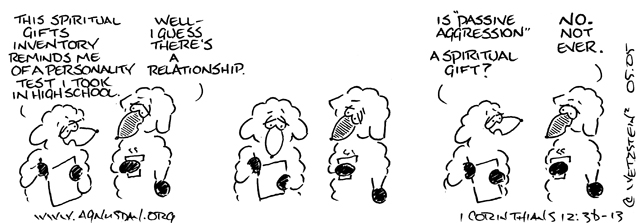
http://www.agnusday.org/strips/1Corinthians12v3to13_2005.jpg
The gift of vocation is so easily subverted from within. Have you found your apostleship, teaching, healing, organizing, etc. subject to passive/aggressive or other tendencies?
So many gifts and so much fear to use them.

http://www.reverendfun.com/?date=20031201
Enough, already, you are who you are and will be who you will be. Time to get on with it, today in front of G*D and everyone, for "better" or "worse".
Ahh, so many gifts and so many ways to respond to them with falsity.
http://www.agnusday.org/strips/1Corinthians12v3to13_2005.jpg
The gift of vocation is so easily subverted from within. Have you found your apostleship, teaching, healing, organizing, etc. subject to passive/aggressive or other tendencies?
So many gifts and so much fear to use them.
http://www.reverendfun.com/?date=20031201
Enough, already, you are who you are and will be who you will be. Time to get on with it, today in front of G*D and everyone, for "better" or "worse".
Thursday, January 21, 2010
1 Corinthians 12:12-31a
Epiphany 3 - Year C
1 Corinthians 12:12-31a
Jesus was filled with the power of Gift.
You are filled with the power of Gift.
OK, there are varieties of gifts, but, please, with Gift there is no way to measure a greater gift from a lesser gift. Don't bother going there or striving there.
If striving is to be done, may it be that we strive to claim our Gift in this moment so that, "Today my Gift is being fulfilled through . . . ." is our rallying cry. When two or three are fulfilling their Gifts together, community is formed and prayers are responded to.
- - - - - - -
Those interested in such as a Gift coming-of-age book would do well to follow the Annals of the Western Shore series by Ursula Le Guin: Gifts, Voices, and Powers.
Wednesday, January 20, 2010
Psalm 19
Epiphany 3 - Year C
Psalm 19
Day says, "Let there be . . . ."
Night wisdom reveals, "And it is good."
Yet evening and morning are not heeded.
The on-goingness of creation carries no weight.
Likewise with laws and revelations, whether G*D's or not
they carry no weight.
Even warned, errors occur and are unrecognized.
So, how do I weigh my own words and heart?
Self-proclaimed as weighty (reprise Sen. Brown's "victory" speech)
and so weightless.
Weightless enough to be blameless and innocent
(not the highest of virtues in an incarnate world).
Now that we know enough to not take ourselves seriously
we can return to the top
to join day and night in
heightened expectation and expansive goodness.
Tuesday, January 19, 2010
Nehemiah 8:1-3, 4-6, 8-10
Epiphany 3 - Year C
Nehemiah 8:1-3, 4-6, 8-10
Once again, all the news that's fit to print, isn't all the news. Even as others as illustrious as Moses have needed help to hold up their hands, Ezra needed others on the platform with him. Likewise, additional others were needed to teach, reinforce, and interpret all the had heard.
When these helpers are left out of the story we have extracted experience from creed. Imagine a Bible reader and a bunch of people. Pretty boring. It is in the interaction in community, beyond a printed page, where life happens. Verse 9c wouldn't have "the people weeping" simply from hearing - the interpreters were and are key and they were left out of this pericope.
Before placing too much on your dulcet tones intoning a communal covenant, remember those standing with you, near or far, and those who will be striving to help others make sense out of what comes out of your mouth. Go ahead, name these folks. The revelation you have to impart will only be enhanced by the naming. You are not in this alone: we're in it together - Ezra and Meshullam and Kelita and you and I.
Luke 4:14-21
Epiphany 3 - Year C
Luke 4:14-21
Jesus, filled with Spirit power, returns to Galilee. What do you do when so filled?
The society column of the time not only noted who poured out at Mrs. Peter's, but who was traveling and where. The editorialists and pundits picked up on yet another bandwagon and wrote and talked, repeatedly, about the significance of Jesus as though he were an extension of their own preferences.
All these reports about Jesus were leading to confusion. On the appropriate Sabbath, Jesus took advantage of the reading of the day to proclaim, in no uncertain terms, in very certain class, economics, and power terms the trouble he was brewing - a revolutionary vision for the mobilization of the poor, freedom unreasonable seizure, reform of the privileged, and overcoming oppression. This was not only a challenge end and means of systems, but a challenge not to be delayed for another year (much less 49 years) - a challenge for right now, this year.
A follow-up question to what you do when Spirit-filled (become a brewer of trouble), asks when you will do it. Well? Any reason not to have your spirit-filling revealed today?
Friday, January 15, 2010
variety
Epiphany 2 - Year C
variety
a most uncommon
common-good
dispersed
so widely
none can claim
status
miraculous
it is to use
miracle to hold
gift to gift
intermingled
interpretation balances wisdom
tongues and knowledge are paralleled
miracle sits in the middle
that is no middle
faith requires discernment
healing instructs
water
universal solvent
homeopathic intensifier
brings forth
wine
rejoice
for my sake
names change
dawn
steadfast
love-winged
gifts
Thursday, January 14, 2010
1 Corinthians 12:1-11
Epiphany 2 - Year C
1 Corinthians 12:1-11
I am always amused and aggravated at the way Paul can so easily slip from an either/or didacticism regarding Jesus' "name" to an open-ended appreciation of variety of gifts attributed to a Spirit of this same Jesus. I experience no harm to this pericope should verses 2 and 3 happen to get erased or not spoken when reading. Try it: 1 Corinthians 12:1, 4-11.
With that detail cared for, consider again the variety of images of G*D that G*D seems to have an appreciation for. They range from deserts to your life this day. All the named and unnamed gifts are expressions of an original blessing. Perhaps you will appreciate Chris Smither's song, "Origin of Species" - lyrics and performance.
For those of you who aren't into links, here is the pertinent section of the song:
God said: "I'll make some DNA"
They can use it any way they want
From paramecium
Right up to man."
"They'll have sex
And mix up sections of their code
They'll have mutations...
The whole thing works like clockwork over time."
"I'll just sit back in the shade
While everyone gets laid.
That's what I call
Intelligent design."
Yeah, you and your cat named Felix,
Both wrapped up in that double helix,
Is what we call
Intelligent design.
Paul calls this DNA "the same G*D who activates [each gift]". Appreciate an Original Blessing or First Gift that has manifested as you. Pretty amazing, are you!
Wednesday, January 13, 2010
Psalm 36
Epiphany 2 - Year C
Psalm 36
In the first verses we find "personified Transgression" living through those who listen to it. There is mischief afoot.
In the final verse the "evil doers" or "moral midgets" are found sprawled on the ground having tripped over their own mischievous feet.
Hints about how to avoid this comeuppance are found in the middle two verses. Here we are reminded about the value of a solidly grounded sense of rightness with judgments based on firm foundations and oriented toward the long-term. Here we know that salvation is universal; it is for all and won't be complete for me until it is complete for you and other parts of creation. Here we have affirmed love that is steadfast, regardless of any separations to date. Here we are called to be sources of refuge winging hope to the despairing.
In this middle section we have a protocol for water changing to wine, scoundrels turning round right, and apathy become advocacy.
Tuesday, January 12, 2010
Isaiah 62:1-5
Epiphany 2 - Year C
Isaiah 62:1-5
For whose sake will you not shut up? Let us count those who covet our voice.
Yes, the list will extend past our ability to count and also reveal our bias and our blindness. It is important to start anyway. Are you willing to list 5 for whose sake you will not be quiet.
Here are five to get the ball rolling, add five more and send the list on to others. It would be interesting to see the results of several lists after they have been added to a dozen or so times.
- those diminished by others for their sexual orientation
- those constrained by mental illness
- those victims at every level by war (including those perpetrating such)
- those who simply hunger and thirst
- those whose words are but shadows of their thoughts and feelings
and yours?
-
-
-
-
-
To what end will we speak up? That those spoken for, and all, might see themselves crowned with beauty, delighted, and in community.
Monday, January 11, 2010
John 2:1-11
Epiphany 2 - Year C
John 2:1-11
Ahh, the magic three-day time-frame. What can't happen on a third-day!
Immediately prior to this is a call to Philip and Nathanael. They are promised a variation of Jacob's ladder, with "the Son of Man" as a ladder upon which angels scamper to-and-fro. You can almost hear these newly-called talking after their initial experience, "All very exciting now, I think we need to see what happens on the the third day before we believe more deeply than exclaiming an honored title."
Turns out it was an experience that confirmed their call. Mary's angelic messenger was extra speedy running up and down that ladder. Water was turned to wine: Jesus' whine was turned to sign.
Well, by metaphoric definition, this is a third-day - as is any ordinary day. What can't happen on a third day! Are you still looking to find out? Let us know what you find.
[Note: Metaphoric definitions are the best kind. Go ahead, make some up.]
Friday, January 08, 2010
Attached
Epiphany 1 - Year C
how does it feel
to follow a late star
no not Theda Bara
a star star in the sky sky
everything seems
on track
when you are
hitched to a star
then lost focus
disappointing enough
to appeal to authority
when only you have it
even late in time
star time meets earth time
gifts are given
expectations met
needs are great
saviors are late
13 or 30 years late
so many stars come and gone
a star child
needs more than wishes
so a star bird
attaches "pleased"
connections made
star gifts
star dove
new wisdom
beloved chosen
into hands received
entrusted again and again
star new risen
Thursday, January 07, 2010
Acts 8:14-17
Epiphany 1 - Year C
Acts 8:14-17
This dualism of the "word of God" and "Holy Spirit" presents a number of difficulties. It seems more institutional than experiential or helpful.
The same goes for a dry baptism in Jesus' name and a wet baptism of sweaty hands. Apparently baptism is not baptism is not baptism in the reverse of a rose, rose, rose. Again we get distinctions of particulars that will lead to division rather than a unity of integral growth in each life.
A social justice question rises here. Suppose you hear that someone has a new lease on life, a hope of freedom, are you going to go to them to say, "You're deluded about your new perspective on meaning, interpret it according to my experience and you'll be much better off."? Think back to the Civil Rights movement. Folks had a new word to follow and so many wanted them to add on another layer of work through the legislative means to legitimate their view.
Think ahead to the need for clean water in Cambodia. Through Deanna Shimko and others, a word of God had been heard and pumps installed. Can you imagine telling them that they they should hold off on that word and work until flouride can be added to the water?
This need to control experience was, is, and will be deadly, whether it is about G*D or sexual orientation. The Church gets both badly wrong when it operates from a "here's the way it happened to me and so this is the way it should happen to you" mentality.
Wednesday, January 06, 2010
Psalm 29
Epiphany 1 - Year C
Psalm 29
Very much an appeal to the vanity of any ruler. Ten verses extol the leader and the eleventh reveals the end to which the praise is oriented - give the brownnoser strength, blessing, peace on their terms (all euphemisms for rain). A psalm about water rights.
I suppose it would be a pleasant change of pace to have the Fox Network try this approach in their relations with President Obama. However, it is not the methodology of our time. Can you imagine Bill O'Reilly or Keith Olbermann or Glen Beck or Ed Schultz building up their opponent first (without a sarcastic sneer in their voice) to be able to best describe their need for a refreshing shower?
How do you go about appealing for relief? Praise or Protestation?
Tuesday, January 05, 2010
Isaiah 43:1-7
Epiphany 1 - Year C
Isaiah 43:1-7
What a revelation it is when we hear our name called by creation. Our fears - relieved, our context - widened, and our participation - precious. We see ourselves through a telescope backward, changing our perspective from the up-close to a larger context tying us to past and future in such a way that our present is honored as a connection spot, a place to connect the dots of all the scattered people.
We open our eyes and dive in to enjoy swimming in a river that is never the same.
Monday, January 04, 2010
Luke 3:15-17, 21-22
Epiphany 1 - Year C
Luke 3:15-17, 21-22
So often we look at Scripture through the lens of individual heroes. Today look at the People as a collective hero. Revelations come not just through John about what it is not, but also through the People about their state of being.
Behold, more people than expected, including Jesus, came out to Brother John. This is not just a draw from John, but a push from their expectations, their hope, their need, their desire, their wonder.
In some sense it is the expectancy of the people at work here and John is but one of their focal points as they search out evidence for their hope still dwelling below the surface.
The missing verses show us Wilderness John imprisoned. The people have been imprisoned. The people ask, "Are you the one we expect?" Later John will ask that same question, "Are you the one we expect?"
Even today the question is being asked of you and me, "Are you the expected one?" Well, it is time to respond. Are you the best shoe tier where you are - recognizing who needs your support and giving them more time, energy, and resources than is practical? Claim it and support. Are you the best one around to lead those with the same passion as yourself? Claim it and lead.
Who you are not is important, but it leads to other questions about how you will live, not how you won't live. Remember it is important to be among people with expectations, that's where Jesus surfaces from in this telling. In the midst of simply doing what expectant people do, Jesus receives his recognition about himself and off he will set. In the midst of simply doing what expectant people do, may you receive your next vocational recognition.
Wednesday, December 30, 2009
Psalm 147
Christmas 2 - Year C
Psalm 147
Next year, the Sunday after Christmas, we will hear again Rachel wailing in Ramah. At what point in Rachel's experience would she have found this psalm to resonate?
Would she need to hear it before she wailed that it might be background to all else?
Is she able to sing it along with laments during a slaughter of innocents? (Remember your response to this includes the "collateral damage" done to children on this very day, even though we may not hear about it, by poverty in any city in the proverbial richest country of the world and by that same country's army and bombs in far off countries. Can you sing this psalm today?)
Will she only be able to join this psalm at some future time similar to Job two-fold restoration?
For the moment I am tired of bragging up G*D. How might we better work together for a common good and commonwealth? These boom and bust cycles are wearing us out.
Tuesday, December 29, 2009
Jeremiah 31:7-14
Christmas 2 - Year C
Jeremiah 31:7-14
We do like underdogs to pull out a win at the end. Jeremiah's tale is similar to other parts of a larger story. There is a lot of praise when the tables are turned and refugees return home.
As we continue on we might expect that praise will go to our heads and we will think that God is on our side, no matter what. Our praise and pride will falter and fall. Off we go to experience another lesson, whether learning eventuates or not. Hopefully, as part of a larger group story, we'll figuratively return.
There is nothing in the praise that helps us with the practical business of living day-to-day. In many ways it distracts us.
Let's presume a new start is being made. Block out the congratulations for a moment. What is a practical step that might help. This coming Sunday I'm preaching off-lectionary at a UU Fellowship about "One and All: A Consensus Approach". Might intentionality in this arena help get us out of the boom and bust cycles we have had through religious history? I wouldn't and couldn't claim it to be a guarantee as consensus processes can be blocked, but it is a helpful tool that needs more attention.
What would a consensus process look like between G*D and you and yours and others? How would it differ from the praise emphasis of this pericope? It's not too late in the week to get some input to me. Thanks.
Monday, December 28, 2009
John 1:1-18
Christmas 2 - Year C
John 1:1-18
Are you enlightened yet? Surely you must be for "the true light, which enlightens everyone, was coming into the world" (verse 9) and the implication of the scripture is that such a true light not only was coming, but has come into the world. So surely you must be enlightened.
Have you stumbled over your own feet again? What happened to that enlightenment?
The world around you gone awry? What happened to that enlightenment?
Again and again our G*D-begottenness has bumped into our blood-begottenness, flesh-begottenness, sex-begottenness (as The Message puts it) and been forgotten in the melee of begottennesses.
Welcome back to a new beginning spot with darkness hovering. As you go about your cultural business of planning a resolution or two, it will be helpful to choose one that realistically takes in all these different aspects of begottenness. If you are simply choosing a resolution on a meta-Word level, disappointment will come quickly enough. The more aspects of yourself you take into account the longer that disappointment will be put off (but not entirely, remember John's question after awhile - are you really who we once thought you were?).
Are you enlightened enough, yet, to question your enlightenment? If not all this high christology will catch you again having thought all was cared for rather than all still growing, falling and rising, evening and morning.
Friday, December 25, 2009
an absent gift
Christmas 1 - Year C
every year we look to be
returned to Jerusalem
every year we go
to Jerusalem
expecting something new
expecting no change
expecting to be surprised
by no surprise
returning home
no change
but then
absence
in such absence
we return to Jerusalem
with intent
and in tension
no longer caught
on dilemma's horns
we listen
we question
and we find
larger questions
deeper listening
new searching
binding us together
in wisdom
years
favor
Christmas Day
Christmas Day - Year C
John 1:1-8
Isaiah 52:7-10
Psalm 98
Hebrews 1:1-12
Going through a long line of prophets, G*D addressed our ancestors in different ways in different times. Recently G*D spoke directly to us through You. [Hebrews 1:1-2]
You have sung a new song of wonder: wonder that righteousness and fairness are still possible. [Psalm 98:1, 9]
This beautiful song of yours scampers across mountain ranges, echoing from friend to friend. Nothing can hold it back. Peace/Salvation/Wholeness are the comfort, the strength, you offer. [Isaiah 52:7-10]
So it has been from the beginning. Word and G*D and G*D and Word dance new beginnings through a present You. This Word and G*D and You brighten every darkness for in You is Life and this Life is Light. Witness. [John 1:1-7]
- - -
Bonus Material: A Christmas Wish
Thursday, December 24, 2009
Christmas Eve
Christmas Eve - Year C
Luke 2:1-20
Isaiah 9:2-7
Psalm 96
Titus 2:11-14
It doesn't matter if there was actually a census or not. An intent to register in order to dominate is sufficient. This was the state of the world - regimented. Was?
Into this legalization comes a child (coming through its mother's line - read Sarah the Priestess: The First Matriarch of Genesis by Savina Teubal and extrapolate from there) a-lying in a manger. This swaddled child of a matriarch is a sign of a new way of doing business. From this generalized description of a child and a manger there is heard a far off hymn of new creation come close enough to make out the words, "Glory . . . Peace." [Luke]
Of course our tendency is to take this antiestablishmentarianism of a manger child capable of throwing a wrench into the gears of registrations and to turn it into the opposite of what we have experienced. Hooray, I get to be in charge. And, of course, that will bring with it grand titles and an assumption of knowing what is just and righteous. How many times has that turned sour on us. [Isaiah]
If we don't take that direct approach to overthrowing the regimenters, we sit back and sing a song of an active God - great and greatly to be praised. It won't be long before the pie in the sky sets everything right and treats everyone fairly. Keep singing those carols. [Psalm]
And didn't you just know the catch to all this is blood atonement. G*D's readiness to give and forgive demands sacrifice. A simple baby in a manger must become God and Savior and dead before being effective. [Titus]
Perhaps we simply need to go back to a baby, any baby. It is urge to birth that brings the light back, a return of complex justice, a continually new song, and giving and forgiving. Look behind an aborted, a stillborn, a genetically compromised, a socially untenable, a healthy birth - any - each is a sign to us in the darkness - fecundity pushes onward. Now we can even claim our birth and the weird way our journey has been woven as a sign in the darkness. May we release the Glory within to become the Peace around and about.
The angels have returned from whence they came, leaving you and me, baby signs. Ready, set, go! [Wesley]
Colossians 3:12-21
Christmas 1 - Year C
Colossians 3:12-21
First be swaddled with compassion, kindness, humility, quiet strength, and patient discipline.
First swaddle others with compassion, kindness, humility, quiet strength, and patient discipline.
Yes, that is two "first's". Most of us will find one first will takes priority over the other. Some can't give until they receive. Others can't receive until they give. We can get to both from either direction. Enjoy your process.
With verse 12 under our belts, we can leave the following redundancies to themselves and not get caught up in the subsequent "oughts".
It's good to know that this way of living can come out of a doo-doo manger mess or an event in your life today. Whether echoing from long ago and far away or brightly singing forth in this new moment, swaddle and be swaddled.
Subscribe to:
Posts (Atom)